
Reference
How to call any country
Every guide gives you the same three things: the exit code you dial, the country code that follows it, and the digit you have to drop from the local number. Plus the time difference, so the call is actually answered.
Reviewed by Sujan ThapaliyaLast updated
How do you make an international call?
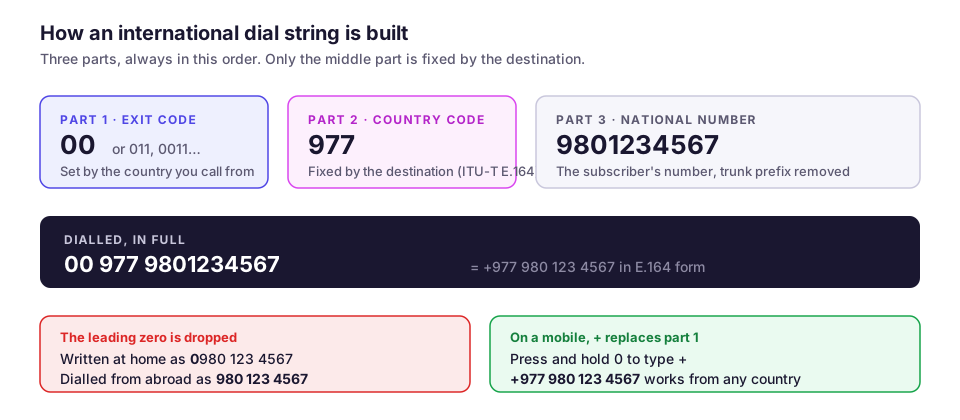
Dial your country’s international exit code, then the destination country code, then the local number with its leading trunk digit removed. From the US and Canada the exit code is 011; across most of Europe and Asia it is 00; from Australia it is 0011. On any mobile, dial + instead; it works from every country.
Exit codes
What to dial before the country code
The exit code depends on where you are calling from, not where you are calling to. This is the part most guides get wrong.
| Calling from | Exit code |
|---|---|
| United States, Canada | 011 |
| Most of Europe, Asia, Africa, South America | 00 |
| Australia | 0011 |
| Japan | 010 |
| Taiwan | 002 |
| Hong Kong, Singapore, Thailand, Indonesia, South Korea | 001 (varies by carrier) |
| Russia | 8 then 10 |
| Nigeria | 009 |
| Kenya | 000 |
| Any mobile, anywhere | + (press and hold 0) |
From the United States
Calling out of the US
Dial 011, then the country code, then the local number without its leading 0.
Asia
Caribbean
Europe
- Call Austria+43
- Call Belgium+32
- Call Croatia+385
- Call Cyprus+357
- Call Czech Republic+420
- Call Denmark+45
- Call Finland+358
- Call France+33
- Call Germany+49
- Call Greece+30
- Call Hungary+36
- Call Iceland+354
- Call Ireland+353
- Call Italy+39
- Call Luxembourg+352
- Call Netherlands+31
- Call Norway+47
- Call Poland+48
- Call Portugal+351
- Call Romania+40
- Call Russia+7
- Call Serbia+381
- Call Spain+34
- Call Sweden+46
- Call Switzerland+41
- Call Turkey+90
- Call Ukraine+380
- Call United Kingdom+44
Latin America
Middle East
North America
Into the United States
Calling the US from abroad
Calling the United States from abroad
- From Aruba00
- From Australia0011
- From Austria00
- From Bahamas011
- From Belgium00
- From Belize00
- From Bermuda011
- From Brazil00 + a 2-digit carrier code (for example 0021)
- From Canada011
- From Chile00 (or a carrier-selection code)
- From China00
- From Colombia00 + carrier code (005, 007, or 009)
- From Denmark00
- From Dominican Republic011
- From France00
- From Germany00
- From Honduras00
- From Hong Kong001 (or another carrier prefix)
- From Iceland00
- From India00
- From Ireland00
- From Israel00 (or a carrier code such as 012, 013, 014)
- From Italy00
- From Jamaica011
- From Japan010
- From Malaysia00
- From Mexico00
- From Netherlands00
- From New Zealand00
- From Norway00
- From Pakistan00
- From Panama00
- From Philippines00
- From Portugal00
- From Saudi Arabia00
- From Singapore001 (or another carrier prefix)
- From South Korea001, 002, or another carrier prefix
- From Spain00
- From Switzerland00
- From United Arab Emirates00
- From United Kingdom00
Frequently asked questions
What is the general format for an international call?
Exit code + country code + local number, with the local number's leading trunk digit removed. From the US that is 011 + country code + number. From a mobile you can replace the exit code with a + symbol, which works from any country.
Why does my international call not connect?
Four causes cover almost all of them: you kept the leading 0 on the local number, you used the wrong exit code for the country you are calling from, your carrier has international dialing barred on the line, or the destination requires a mobile-specific prefix; Argentina's 9 after +54 is the classic example.
Is it cheaper to call over the internet?
Almost always. Carrier international rates are typically many times VoIP per-minute rates. Calling from an owned number in the destination country is cheaper still, and it means the person you called can ring you back.
Can I call any country from a browser?
Yes. A softphone in the browser places calls over the internet to any destination, and bills per second from a prepaid wallet rather than through a mobile carrier's international tariff.
Sources
- ITU-T Recommendation E.164 — The international public telecommunication numbering plan — International Telecommunication UnionThe international number format, the 15-digit maximum, and how country codes and national numbers compose.
- ITU-T International Numbering Resources — International Telecommunication UnionThe assignment of country calling codes and the published national numbering plans they belong to.
Skip the international tariff entirely
Call any country from your browser or phone at published per-second rates, from numbers you own. If you call one country often, a local number there means people can call you back for free.
- Per-second billing
- Numbers in 100+ countries
- No subscription