
What is a power dialer?
How it works
Power dialer in four steps
No implementation project. Most teams are dialling the same day they sign up.
- 1
Load a list
Import a CSV or pull a segment from your CRM. Numbers are validated, formatted to E.164, and screened against your do-not-call and suppression lists before a single call goes out. - 2
Set the pace
Choose the delay between calls, the calling window in the contact's own time zone, and which of your owned numbers to present as caller ID. - 3
Dial through
The dialer places one call, waits for a human, and connects the rep instantly. No ring-out on the rep's side, no abandoned calls on the prospect's. - 4
Disposition and move on
One keystroke logs the outcome, writes it back to the CRM, schedules the follow-up, and starts the next call.
Capabilities
What you get
One call at a time
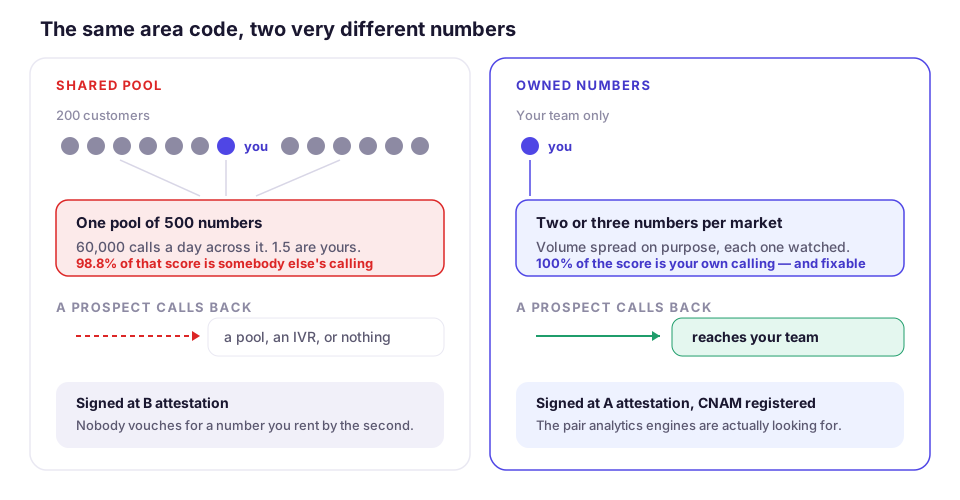
Local presence from owned numbers
Branded caller ID
Built-in compliance
Disposition-driven follow-up
Live coaching
How much time does a power dialer actually give back?
The claim is usually stated as a multiple, which is useless without knowing what it multiplies. The honest version is arithmetic: a rep dialling manually spends roughly 45 seconds per attempt on lookup, keying, ring-out and note-taking. At 60 attempts a day that is 45 minutes of work that produces no conversation at all.
| Manual dialling | Power dialling | Difference |
|---|---|---|
| Look up and key the number, 20s | Dialled from the list, 0s | 20s per attempt |
| Wait through ring-out, 18s | Same, 18s | none — this is the network |
| Type the outcome, 25s | One keystroke, 3s | 22s per attempt |
| ≈ 60 attempts a day | ≈ 130 attempts a day | the same hours |
Two things follow. The gain is in attempts rather than in answer rate, so a list that answers badly will produce more of the same nothing, faster. And the gain caps out: once the dead time is gone, the only remaining lever is how many of those attempts reach a human, which is a deliverability question rather than a dialling one.
Why a power dialer cannot abandon a call
One line per rep means a live answer always has somebody waiting for it. That is not a feature setting, it is arithmetic, and it is the reason regulated sellers who cannot risk an abandoned call use power dialling rather than predictive. The abandonment rules that govern predictive dialing simply have nothing to attach to here.
It is also why the mode is the sensible default for a team that has not measured its list yet: it removes the waste without adding exposure, and the connect rate it produces is the number you need before deciding whether parallel dialling is worth the complexity.
Fit
Who a power dialer is right for
If none of these describe you, a different mode probably fits better; the comparison pages lay out the trade-offs honestly.
- SDR and BDR teams working curated lists where every conversation matters
- Account executives doing follow-up cadences rather than cold volume
- Regulated industries that cannot risk abandoned calls
- Small teams that want dialling automation without a call-centre deployment
Frequently asked questions
What is the difference between a power dialer and an auto dialer?
Will a power dialer get my numbers flagged as spam?
How many more calls will my reps make?
Does it work with my CRM?
Sources
- Telemarketing Sales Rule — Federal Trade CommissionDo-not-call obligations, abandonment-rate limits for predictive dialing, and required call disclosures.
- 47 U.S.C. § 227 — Restrictions on the use of telephone equipment — Cornell Legal Information InstituteThe Telephone Consumer Protection Act itself — the consent requirements, calling-hours limits, and private right of action.
- National Do Not Call Registry — Federal Trade CommissionThe registry that outbound calling lists must be scrubbed against.
Try power dialer without a contract
No seat licences, no minimum commitment. Add a number, top up a wallet, and start. Release the number whenever you like; your remaining balance stays yours.
- No subscription
- Owned numbers with Attestation A
- Compliance built in