
Free tool
Can I call them now?
Pick a country and see the current local time there, alongside a straight answer about whether now is a sensible moment to pick up the phone.
- No sign-up
- Runs in your browser
- Nothing is sent to a server
Reviewed by Sujan ThapaliyaLast updated
Is it a good time to call?
Step by step
How to use the call time checker
- 1
Pick the destination
Choose where you are calling. The tool reads the local time there right now rather than making you do the arithmetic. - 2
Check it against the calling window
Outbound calling rules are measured in the recipient's local time, not yours. In the US the Telemarketing Sales Rule confines telemarketing calls to 8am–9pm where the person being called is. - 3
Schedule rather than dial
If the window is closed, queue the call for when it opens. A call placed outside the permitted hours is a compliance problem however good the reason was.
How it works
Why calling hours are a compliance problem, not a courtesy
Under the TCPA, telemarketing calls to US consumers are restricted to 8am–9pm in the called party’s local time zone. Several states narrow it further. Each call outside that window is an independent violation carrying statutory damages of $500 to $1,500, and a modest campaign run an hour early produces exposure measured in six figures.
The trap is that area code is a bad proxy for time zone. Number portability means a 212 mobile may sit in California, and a 415 number may have moved to Texas years ago. Any system that derives the calling window from the area code alone will be wrong for a meaningful slice of every list.
This is why calling windows belong in the dialer rather than in a policy document. A rule that depends on a rep checking a world clock will fail at volume, and every failure is separately actionable.
Frequently asked questions
What is the best time to make a business call?
What hours am I legally allowed to make telemarketing calls?
Which countries do not have a Saturday–Sunday weekend?
Why does the time difference keep changing?
Sources
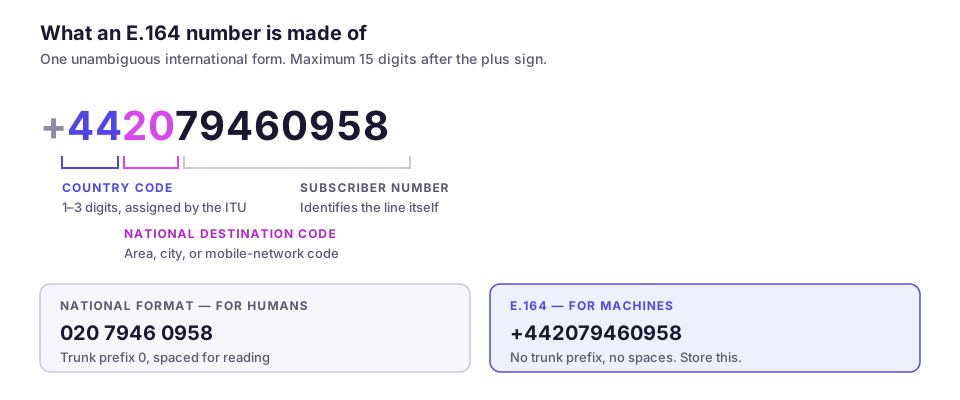
- ITU-T Recommendation E.164 — The international public telecommunication numbering plan — International Telecommunication UnionThe international number format, the 15-digit maximum, and how country codes and national numbers compose.
- ITU-T International Numbering Resources — International Telecommunication UnionThe assignment of country calling codes and the published national numbering plans they belong to.
Let the dialer enforce the window
Calling hours are applied per contact in their own local time, and any campaign that would breach the window is simply held rather than dialed. Nobody has to watch a clock.
- No subscription
- Numbers in 100+ countries
- Compliance built in