Free tool
Area code lookup
Type a code or a city and find out where it is, what time it is there, which overlays share the territory, and whether the code is real at all.
- No sign-up
- Runs in your browser
- Nothing is sent to a server
Reviewed by Sujan ThapaliyaLast updated
- 800Toll-free (nationwide)Toll-free code: the called party pays. In service since 1966.
- 833Toll-free (nationwide)Toll-free code: the called party pays. In service since 2017.
- 844Toll-free (nationwide)Toll-free code: the called party pays. In service since 2013.
- 855Toll-free (nationwide)Toll-free code: the called party pays. In service since 2010.
- 866Toll-free (nationwide)Toll-free code: the called party pays. In service since 2000.
- 877Toll-free (nationwide)Toll-free code: the called party pays. In service since 1998.
- 888Toll-free (nationwide)Toll-free code: the called party pays. In service since 1996.
- 822Not assigned to any regionNot assigned to any region in the North American Numbering Plan.
- 900Non-geographicNon-geographic code, not tied to any city or state.
- 710Non-geographicNon-geographic code, not tied to any city or state.
- 600Non-geographicNon-geographic code, not tied to any city or state.
- 456Non-geographicNon-geographic code, not tied to any city or state.
How do you find out where an area code is?
Step by step
How to use the area code lookup
- 1
Enter the three digits
Type an area code, or search by city or state to find which codes serve it. Codes that are not in service are flagged rather than hidden, because those are the ones that turn up on spoofed caller ID. - 2
Check what kind of code it is
Geographic codes map to a place. Toll-free codes such as 800 and 888 map to no place at all. Codes starting 0 or 1 are not valid area codes and cannot belong to a real subscriber. - 3
Dial it correctly
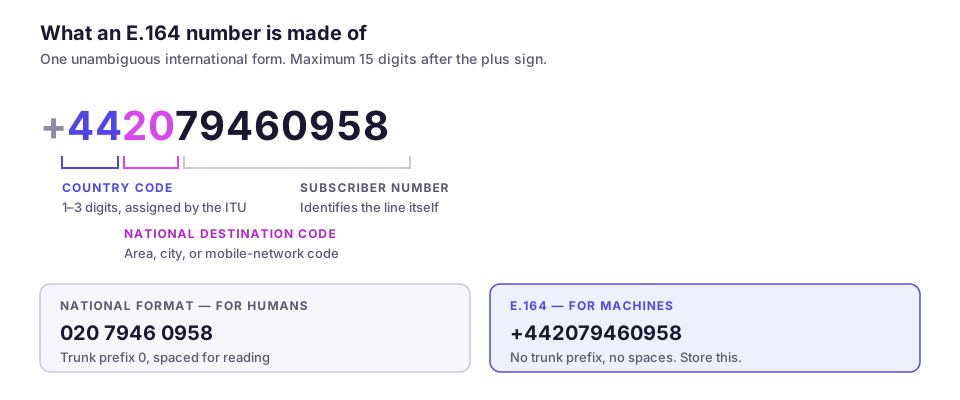
Ten digits within North America, prefixed with 1 for long distance, or +1 followed by the ten digits from anywhere else in the world.
How it works
What an area code can and cannot tell you
Area codes were designed in 1947 to route calls geographically, and for forty years they did exactly that. Two things broke the assumption that a code tells you where someone is:
- Number portability. People keep their mobile number when they move. A 212 number today may belong to someone who has not lived in Manhattan for fifteen years.
- Overlays. When a code runs out of numbers, a second code is laid over the same territory rather than splitting it. That is why 213 and 323, or 801 and 385, serve identical areas and why ten-digit dialing became mandatory.
What an area code is still good for is time zone, which is why every code page here names one. If you are calling back an unknown number, knowing whether it is 7am or 7pm there is usually the more useful fact.
Frequently asked questions
How do I find out where an area code is?
Can I look up who owns a phone number?
Why does my caller ID show an area code that does not exist?
What is my area code?
Sources
- ITU-T Recommendation E.164 — The international public telecommunication numbering plan — International Telecommunication UnionThe international number format, the 15-digit maximum, and how country codes and national numbers compose.
- ITU-T International Numbering Resources — International Telecommunication UnionThe assignment of country calling codes and the published national numbering plans they belong to.
Get a number in any area code
Own a local number in the market you sell to, put your business name on the caller ID, and route callbacks straight to your team. Local numbers get answered; branded ones far more so.
- No subscription
- Numbers in 100+ countries
- Compliance built in