
Reference
Phone number formats by country
Digit counts, mobile and landline prefixes, trunk-prefix rules, and E.164 examples: the reference you actually need when you are writing validation or cleaning an import file.
Reviewed by Sujan ThapaliyaLast updated
What is the correct international phone number format?
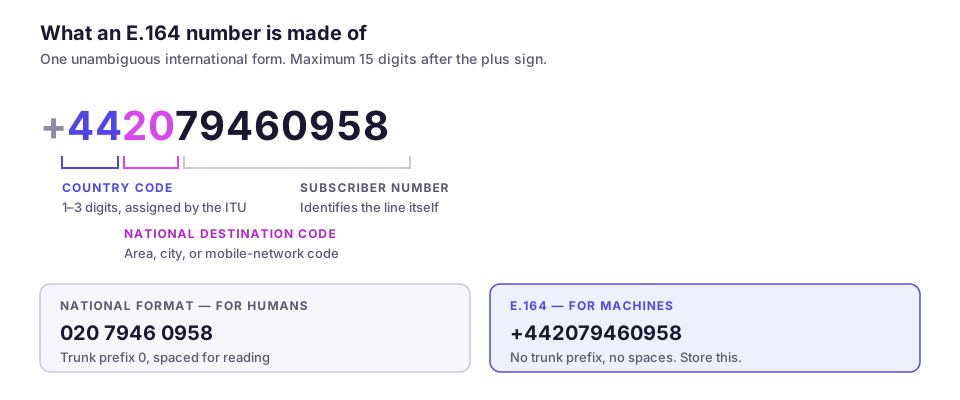
E.164: a leading +, the country calling code, then the national number with no spaces, dashes, or brackets, and at most 15 digits in total. Any national trunk prefix (the leading 0 in most of Europe, Asia, and Africa) is removed. It is the only format that is unambiguous everywhere, and the only sensible way to store a number.
At a glance
Which country formats get looked up most?
Mobile examples, written the way they appear domestically and in E.164.
| Country | Code | Mobile pattern | E.164 example |
|---|---|---|---|
| United States | +1 | +1 (NPA) NXX-XXXX (same format as landline) | +12125550187 |
| United Kingdom | +44 | +44 7XXX XXXXXX | +447700900123 |
| Germany | +49 | +49 1XX XXXXXXX | +4915112345678 |
| France | +33 | +33 [67] XX XX XX XX | +33612345678 |
| India | +91 | +91 XXXXX XXXXX | +919876543210 |
| Japan | +81 | +81 [789]0 XXXX XXXX | +819012345678 |
| South Korea | +82 | +82 10 XXXX XXXX | +821012345678 |
| Australia | +61 | +61 4XX XXX XXX | +61491570006 |
| Brazil | +55 | +55 XX 9XXXX XXXX | +5511912345678 |
| Mexico | +52 | +52 XX XXXX XXXX | +525587654321 |
Practice
Three rules that prevent most phone-data bugs
- Store E.164, display anything. One canonical value in the database, formatted for humans at render time. Storing the pretty version is how the same customer ends up in your CRM four times.
- Never store a phone number as an integer. Leading zeros vanish, the plus sign vanishes, and no phone number has ever been usefully added to another.
- Validate format, not existence. Format checks belong on the form; whether a number is live is a carrier lookup, and it is the only check that catches disconnected lines before you waste a dial on them.
Directory
All country formats
Each page covers digit counts, prefixes, worked examples, and country-specific quirks.
North America
Latin America
Europe
- Austria+43
- Belgium+32
- Croatia+385
- Cyprus+357
- Czech Republic+420
- Denmark+45
- Finland+358
- France+33
- Germany+49
- Greece+30
- Hungary+36
- Iceland+354
- Ireland+353
- Italy+39
- Luxembourg+352
- Netherlands+31
- Norway+47
- Poland+48
- Portugal+351
- Romania+40
- Russia+7
- Serbia+381
- Spain+34
- Sweden+46
- Switzerland+41
- Turkey+90
- Ukraine+380
- United Kingdom+44
Asia
Oceania
Frequently asked questions
What is E.164 format?
E.164 is the ITU standard for international phone numbers: a leading plus sign, the country calling code, then the national number, with no spaces or punctuation and no more than 15 digits in total. +14155550123 and +442079460123 are both E.164.
How should I store phone numbers in a database?
In E.164, as a string, always. Never as a number: leading zeros and plus signs are lost, and no phone number is ever used arithmetically. Format for display at render time; keep one canonical value stored so deduplication and lookups actually work.
What is the international format for a US phone number?
+1 followed by the ten-digit number: (415) 555-0123 becomes +14155550123. The US has no trunk prefix to remove; the 1 sometimes dialled before a long-distance call is the country code itself.
How strictly should I validate a phone number on a form?
Loosely. Accept spaces, dashes, brackets, and a leading trunk 0, then normalise. Check length and prefix against the country, and stop there. Rejecting a real customer because they wrote their number the way they always write it is far more expensive than storing one odd row.
Can I tell whether a number is a mobile from its format?
In many countries, yes: the UK's 07, India's 6–9 opening digit, Australia's 04. In North America you cannot: mobile and fixed lines share the same format and only a carrier lookup distinguishes them.
Sources
- ITU-T Recommendation E.164 — The international public telecommunication numbering plan — International Telecommunication UnionThe international number format, the 15-digit maximum, and how country codes and national numbers compose.
- ITU-T International Numbering Resources — International Telecommunication UnionThe assignment of country calling codes and the published national numbering plans they belong to.
Let the platform handle the formatting
Every imported number is normalised to E.164, matched to its country, screened against your suppression lists, and displayed correctly, before any of it reaches a dialer.
- Automatic normalisation
- DNC screening on import
- 100+ countries