Free tool
Toll-free number lookup
Check whether a prefix is genuinely toll-free, when it entered service, and what a call from it means, including the prefixes that look toll-free but are not assigned to anyone.
- No sign-up
- Runs in your browser
- Nothing is sent to a server
Reviewed by Sujan ThapaliyaLast updated
- 800Toll-free, in service since 1966The original toll-free code, and the only one most people recognise on sight.
- 833Toll-free, in service since 2017The newest widely available toll-free code, which is why so many 833 calls are unfamiliar.
- 844Toll-free, in service since 2013844 is fully toll-free and functionally identical to 800.
- 855Toll-free, in service since 2010855 is toll-free.
- 866Toll-free, in service since 2000866 is toll-free across the US, Canada, and the Caribbean NANP territories.
- 877Toll-free, in service since 1998877 is toll-free and long established, old enough that most consumers recognise it as legitimate..
- 888Toll-free, in service since 1996888 was the first expansion beyond 800 and remains the second most recognised toll-free prefix..
- 822Not assigned; a call showing this is spoofed822 is reserved for future toll-free use but is not yet in general service.
- 900Non-geographic, not an ordinary phone number900 is the premium-rate range: the *caller* pays, sometimes heavily.
- 710Non-geographic, not an ordinary phone number710 is reserved for US Government use.
- 600Non-geographic, not an ordinary phone number600 is a Canadian non-geographic code used for services such as satellite and machine-to-machine lines, not for ordinary phones..
- 456Non-geographic, not an ordinary phone number456 carries inbound international calls handed off between carriers.
Which prefixes are toll-free in North America?
Step by step
How to use the toll-free lookup
- 1
Enter the prefix
Type a three-digit prefix to check whether it is a toll-free code in the North American Numbering Plan, or one of the ranges that merely looks like one. - 2
Check who pays
On a genuine toll-free code the called party pays for the call, which is exactly why the format is imitated by scam callers. The result tells you which codes are real. - 3
Verify before you trust it
A toll-free number displayed on caller ID proves nothing about who is calling. If a call claims to be your bank, hang up and dial the number printed on your card instead.
How it works
Why there are seven toll-free codes
800 arrived in 1966 and was the only toll-free code for thirty years. When it filled up, 888 was added in 1996, then 877 in 1998, 866 in 2000, 855 in 2010, 844 in 2013, and 833 in 2017. Each addition happened because the previous code had run out of available numbers.
That history explains two things people notice. First, why unfamiliar codes feel suspicious: 833 has existed for a fraction of the time 800 has, so consumers have simply seen fewer legitimate ones. Second, why vanity numbers are still obtainable: nearly every memorable combination in 800 was claimed decades ago, but the newer codes still have room.
Toll-free numbers are portable and administered through a shared national database, so a business keeps its number when it changes provider. That is also why the number on an old invoice usually still works.
Frequently asked questions
Is 833 a real toll-free number?
Is 844 toll-free?
How do I find out who owns a toll-free number?
Are toll-free calls free from a mobile?
Should I trust a call from a toll-free number?
Sources
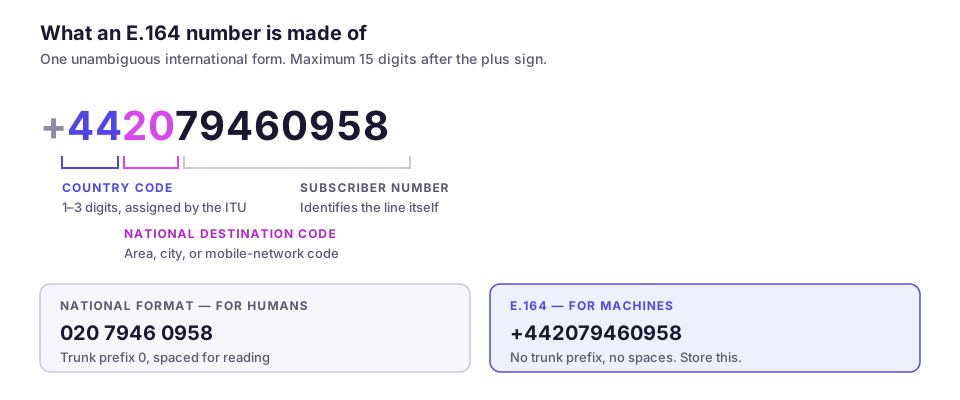
- ITU-T Recommendation E.164 — The international public telecommunication numbering plan — International Telecommunication UnionThe international number format, the 15-digit maximum, and how country codes and national numbers compose.
- ITU-T International Numbering Resources — International Telecommunication UnionThe assignment of country calling codes and the published national numbering plans they belong to.
Get a toll-free number that spells something
The good 800 combinations went decades ago, but 833, 844, and 855 still have room. Claim one, put your business name on the caller ID, and route it wherever you like.
- No subscription
- Numbers in 100+ countries
- Compliance built in