
Dialers
Local presence dialing, done without borrowing anyone's number
Reviewed by Sujan ThapaliyaLast updated
What is a local presence?
How it works
Local presence in four steps
No implementation project. Most teams are dialling the same day they sign up.
- 1
Acquire numbers in the regions you call
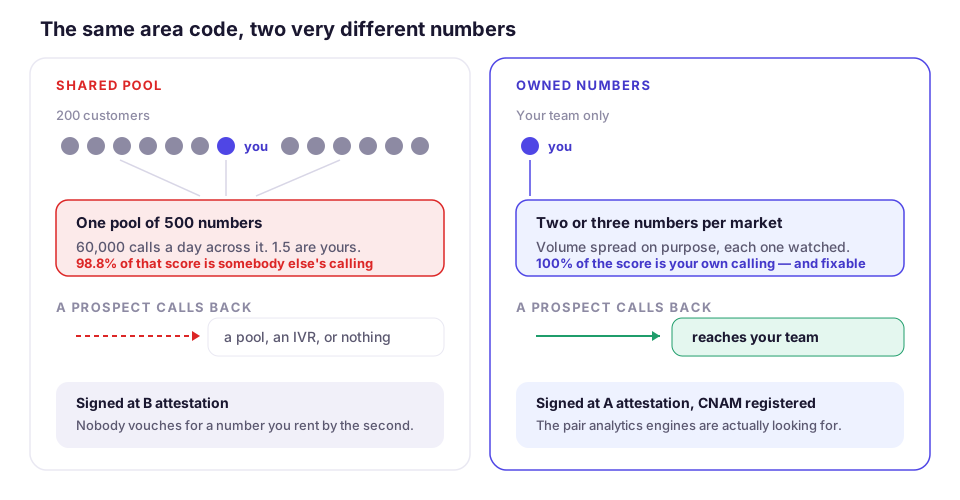
Numbers are provisioned to you in the area codes your list concentrates in, rather than borrowed from a pool shared with other businesses. - 2
Match at dial time
When a contact is dialed, the platform selects the owned number closest to their area code and presents it as caller ID. - 3
Route the callbacks
Every presented number is a live, inbound-capable number that rings your team. A local presence number nobody answers is worse than no local presence at all. - 4
Cap and monitor
Daily dial caps per number and per-number reputation monitoring keep any one local number from being burned by volume.
Capabilities
What you get
Owned numbers, not a rented pool
Callbacks that connect
Per-number daily caps
Reputation monitoring per number
Branded name on regional numbers
Compliance guardrails inherited
Where local presence stops being legitimate
The technique has a good version and a bad one, and they look identical on a slide. The distinction that regulators, carriers and recipients all care about is whether the number you present is a number you control and answer.
| Local presence done properly | Neighbour spoofing | |
|---|---|---|
| The number presented | One you own and pay for | One matched digit-by-digit to the callee, often not yours |
| If they call back | It rings your team, with context | It rings a stranger, or nothing |
| Attestation | Signs at A | Cannot sign at A |
| What it implies | A business with a presence in the region | That a neighbour is calling |
| Where it ends up | A normal caller-ID record | Complaints, labels, and regulatory attention |
Why the technique decayed, and what still works
Local presence worked spectacularly when a local area code was still a reliable signal of a local caller. Three things eroded it: mobile numbers stopped correlating with where people live, analytics engines began scoring area-code churn from single originators, and recipients learned the pattern. What survives is narrower and still real — a genuinely local business, calling a genuinely local list, from a number that answers.
- Own fewer numbers and use them properly. Forty numbers at low volume each looks like snowshoeing; four numbers with real callback paths does not.
- Pair it with a name. A local number with branded caller ID is a different proposition from an anonymous local number.
- Answer the callbacks. The single strongest predictor of whether local presence keeps working for a team is whether returned calls reach a human.
- Watch duration, not just volume. Short average call duration is what analytics engines read as unwanted calling, whatever numbers you use.
The honest version of the pitch
Fit
Who a local presence is right for
If none of these describe you, a different mode probably fits better; the comparison pages lay out the trade-offs honestly.
- Field-based sales covering defined geographic territories
- Real estate and insurance teams calling within a metro area
- Home services and trades whose customers only take local calls
- Any team whose answer rate fell after moving to a single national number
Frequently asked questions
Is local presence dialing legal?
Is this the same as neighbour spoofing?
How many numbers do I need?
Does local presence still work?
Sources
- Telemarketing Sales Rule — Federal Trade CommissionDo-not-call obligations, abandonment-rate limits for predictive dialing, and required call disclosures.
- 47 U.S.C. § 227 — Restrictions on the use of telephone equipment — Cornell Legal Information InstituteThe Telephone Consumer Protection Act itself — the consent requirements, calling-hours limits, and private right of action.
- National Do Not Call Registry — Federal Trade CommissionThe registry that outbound calling lists must be scrubbed against.
Try local presence without a contract
No seat licences, no minimum commitment. Add a number, top up a wallet, and start. Release the number whenever you like; your remaining balance stays yours.
- No subscription
- Owned numbers with Attestation A
- Compliance built in