
Opinion
Local presence dialing is a slow way to burn numbers you don't own
- 8 min read
By Sujan ThapaliyaLast updated
The short answer
Every dialer sells local presence the same way: prospects answer numbers that look local, so match the area code and your connect rate goes up. The claim is true in isolation. What gets left out is where those local numbers come from, and that omission is the entire problem.
On most platforms they come from a shared pool: a block of numbers the vendor owns and rotates across every customer on the plan. You are not given a local number. You are given a turn on one.
You are not buying a local number. You are buying a few seconds of caller ID on a number a hundred other campaigns dialed from this morning.
Three things break, and they break in order
The failure is not dramatic. It arrives as a gradual slide in answer rate that gets blamed on the list, the script, the market, and the reps, roughly in that order, before anyone looks at the numbers themselves.
| Failure | What it looks like from your side | Root cause |
|---|---|---|
| Inherited reputation | Answer rate drops on a list that converted fine last quarter | Analytics engines score the number. The score includes every other customer's calls from it. |
| Dead callbacks | Prospects say they tried to call back and got nothing | The number does not route to you. Return calls hit the pool, an IVR, or a disconnect tone. |
| B attestation | Calls labelled on some carriers and clean on others, with no pattern you can find | Your provider cannot confirm your right to use a number it hands to everyone, so it cannot sign an A. |
The arithmetic of a shared pool
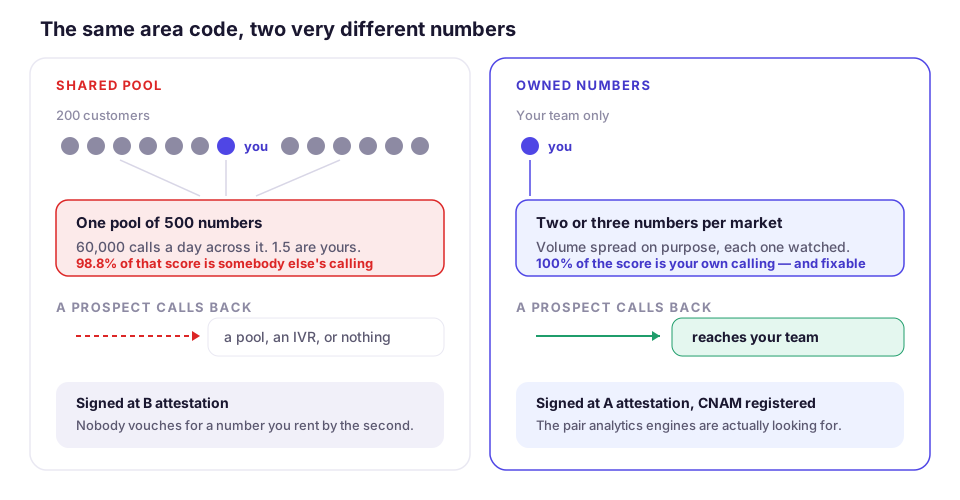
Reputation scoring is per number. That single fact is enough to model what sharing does to you, and the model needs no insider data, only the pool size and the customer count, both of which you can ask any vendor for.
Take a pool of 500 local numbers serving 200 customers. Each customer places 300 calls a day. The pool carries 60,000 calls a day across 500 numbers, so the average number is answering for 120 calls a day it did not make on your behalf for every 1.5 it made on yours.
60,000
Calls a day across the pool
1.5
Of them are yours, per number
98.8%
Of each number's score is someone else's behaviour
You are not managing your number reputation on a shared pool. You are averaging into a pool reputation, and the average is set by whoever on the platform dials hardest. One customer running an aggressive list against a cold market is enough to move numbers you are also using, and you will never be told, because your vendor has no obligation to tell you and no interface in which to do it.
The question that ends the sales call
The rule that actually bites
"Is local presence dialing legal?" is the wrong question, and it is the one the whole industry argues about. In the United States, spoofing caller ID is prohibited when it is done with intent to defraud, cause harm, or wrongfully obtain anything of value. Showing a local number to sell a legitimate product is not that, which is why the practice is widespread and why vendors will tell you it is fine.
The rule that catches shared pools is a quieter one. Telemarketing rules require that the caller ID you transmit include a number the person you called can ring back to ask you to stop calling. Not a number. Your number, reaching you, during business hours.
A caller ID that cannot take a callback is not a caller ID. It is a costume.
A pool number that rings into nowhere fails that plainly. So the compliance exposure is not the local area code; it is the pool. Own the number, point it back at your team, and the same tactic stops being a question at all. The rest of the mechanics are in the full guide to local presence dialing.
Outside the US it is stricter, not looser
The part vendors cannot fix
Attestation is where the shared-pool model runs out of road, because it is not a policy choice; it is a definition. Attestation A means the originating provider authenticated the customer and confirmed the customer's right to use the calling number. A pool number is by construction not yours, so the highest honest signature is a B: we know who this customer is, we cannot vouch for this number.
| Attestation | What the provider is asserting | Available on a shared pool? |
|---|---|---|
| A: Full | Known customer, and this number is theirs | No |
| B: Partial | Known customer, number not verified as theirs | Yes |
| C: Gateway | Call accepted from elsewhere, origin unverified | Yes |
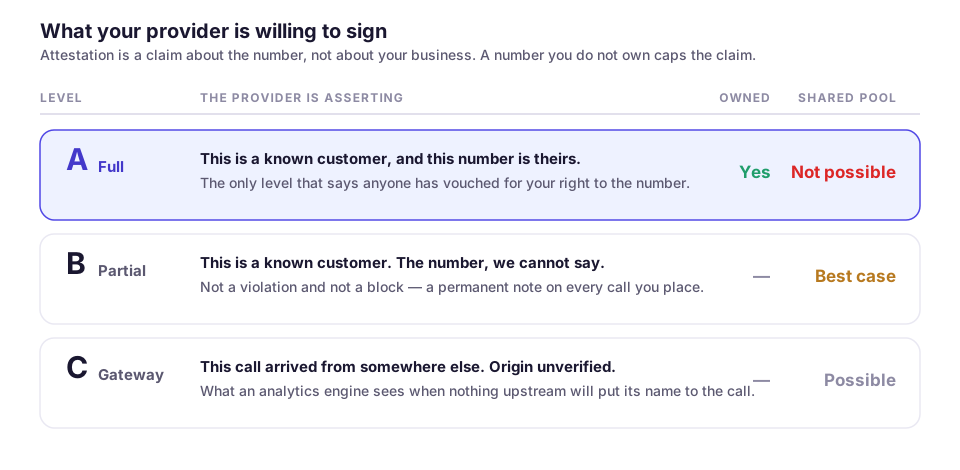
B is not a violation and it is not a blocklist. It is a permanent, machine-readable note attached to every call you place, saying that nobody would put their name to your right to use this number. Analytics engines read it. That is the whole point of it. How attestation and CNAM interact covers what each level does downstream.
What actually works instead
The insight behind local presence is real: a recognisable local number gets answered more often than an unfamiliar toll-free one. Keep the insight. Drop the pool.
- 1
Own a small set of local numbers per market
One to three numbers in each area code you actually sell into. Not fifty. A number you own can be warmed, monitored, registered, and repaired; a number you rent by the second can be none of those. - 2
Point every one of them back at a real destination
Inbound on those numbers should ring your team or an AI voice agent that can book, qualify, or take a do-not-call request. Every callback a pool eats is a prospect who was interested enough to dial. - 3
Register CNAM and get signed at A
Because the numbers are yours, your provider can confirm your right to use them and sign at full attestation. A registered business name plus an A is the pair analytics engines are looking for. - 4
Spread volume, and watch each number separately
Rotate across your owned numbers to keep per-number daily volume in a human range, and track answer rate per number so a slipping one shows up as a line on a chart rather than as a bad quarter. - 5
Retire a damaged number instead of hiding it
If a number picks up a label, remediate it with the analytics providers or replace it. On a pool you cannot do either, because it is not yours to retire.
This is slower to set up and it does not produce a demo where a rep dials Ohio and the screen shows a 614. It produces an answer rate that does not decay, and callbacks that land. Number reputation management is the operating routine that keeps it that way.
The honest version of the pitch
Local presence on owned numbers: your area code match, your reputation, your callbacks, signed at A. Local presence on a shared pool: an area code match, a stranger's reputation, no callbacks, signed at B, for slightly less money.
If your dialer cannot tell you which number a prospect will see, and who else dialed from it today, you do not have a caller ID strategy. You have a lottery ticket.
Both are sold under the same two words. Only one of them still works in the second quarter.
Frequently asked questions
Is local presence dialing legal?
Does local presence dialing still increase answer rates?
Why do my local presence calls get marked as spam?
What is the alternative to a shared local presence pool?
How do I tell whether my dialer uses a shared pool?
Sources
- Combating Spoofed Robocalls with Caller ID Authentication — Federal Communications CommissionThe STIR/SHAKEN framework, the attestation levels carriers sign calls with, and the mandate requiring providers to authenticate caller ID.
- 47 U.S.C. § 227 — Restrictions on the use of telephone equipment — Cornell Legal Information InstituteThe Telephone Consumer Protection Act itself — the consent requirements, calling-hours limits, and private right of action.
- ITU-T Recommendation E.164 — The international public telecommunication numbering plan — International Telecommunication UnionThe international number format, the 15-digit maximum, and how country codes and national numbers compose.
See it working: power dialer
A power dialer places one outbound call at a time from a loaded list, automatically dialling the next contact the moment the previous call ends. It removes manual dialling and hold time without the connection delay that makes predictive dialling feel robotic to the person who answers.
- No subscription
- Numbers in 100+ countries
- Compliance built in