
Glossary · Numbering
What is Local presence?
- Also called: local caller ID, local presence dialing
Reviewed by Sujan ThapaliyaLast updated
Definition
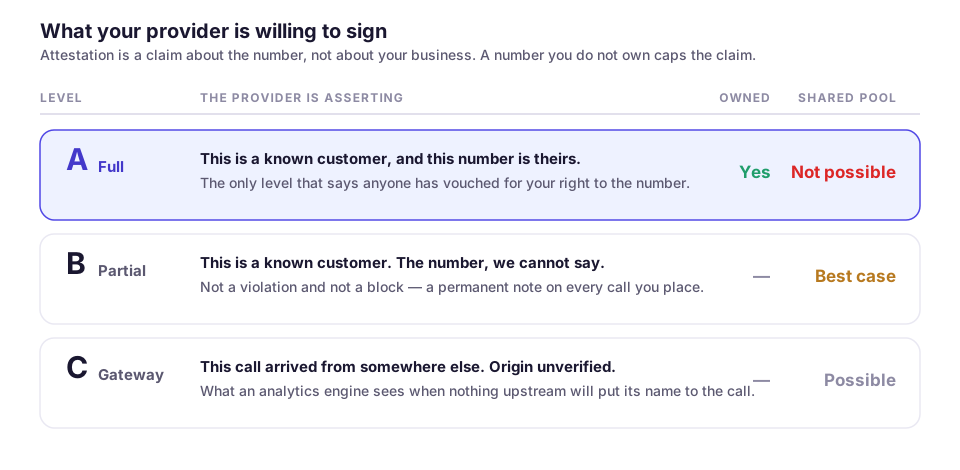
In practice
How local presence actually works
The technique is legitimate when the number is one you own and control, and calls to it reach your team. It becomes illegal caller-ID spoofing under the Truth in Caller ID Act when the number is not yours or is chosen to mislead.
Shared local-presence pools degrade quickly. Numbers are used by many customers at once, accumulate spam complaints from strangers' campaigns, and get labelled, after which the local number performs worse than a plain one.
Because callbacks matter more than answer rate over time, a local number that routes back to a real queue outperforms a slightly better-performing pool number that rings nowhere.
Worked example
Local presence: common questions
Is local presence dialing legal?
Does local presence still improve answer rates?
How is local presence different from neighbour spoofing?
Sources
- Combating Spoofed Robocalls with Caller ID Authentication — Federal Communications CommissionThe STIR/SHAKEN framework, the attestation levels carriers sign calls with, and the mandate requiring providers to authenticate caller ID.
- 47 U.S.C. § 227 — Restrictions on the use of telephone equipment — Cornell Legal Information InstituteThe Telephone Consumer Protection Act itself — the consent requirements, calling-hours limits, and private right of action.
- ITU-T Recommendation E.164 — The international public telecommunication numbering plan — International Telecommunication UnionThe international number format, the 15-digit maximum, and how country codes and national numbers compose.
See local presence in the product
A power dialer places one outbound call at a time from a loaded list, automatically dialling the next contact the moment the previous call ends. It removes manual dialling and hold time without the connection delay that makes predictive dialling feel robotic to the person who answers.