
Glossary · Dialing
What is Voicemail drop?
- Also called: voice mail drop, voicemail blasting
Reviewed by Sujan ThapaliyaLast updated
Definition
In practice
How voicemail drop actually works
The saving is larger than it looks. A voicemail left manually costs 30–45 seconds of dead time; at 60 no-answers a day that is roughly half an hour per rep, per day, recovered.
Voicemail drop is not the same as ringless voicemail. A drop happens on a real call that rang the phone; ringless voicemail inserts a message without ringing, and is regulated separately.
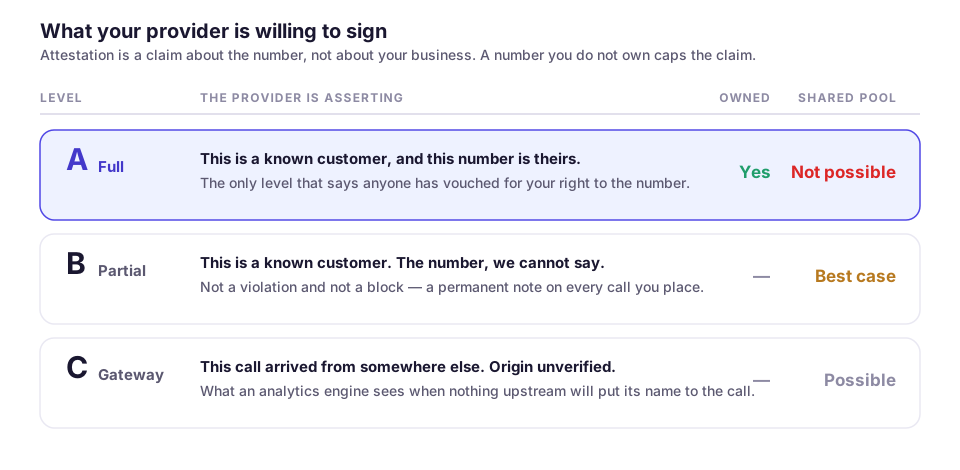
Callback routing decides whether drops are worth anything. If the number you leave is a shared pool number, the callback does not reach you, which is why owned numbers matter more here than message quality.
Drops also compound a reputation problem quietly. Every drop is a call placed, so the dial volume and short duration both feed the analytics score, while the conversation that would have justified the call never happens. On a number already under pressure, a drop-heavy campaign accelerates labelling rather than avoiding it.
Worked example
Voicemail drop: common questions
Is a voicemail drop the same as ringless voicemail?
How long should a dropped voicemail be?
Do consent rules apply to voicemail drops?
Sources
- Combating Spoofed Robocalls with Caller ID Authentication — Federal Communications CommissionThe STIR/SHAKEN framework, the attestation levels carriers sign calls with, and the mandate requiring providers to authenticate caller ID.
- 47 U.S.C. § 227 — Restrictions on the use of telephone equipment — Cornell Legal Information InstituteThe Telephone Consumer Protection Act itself — the consent requirements, calling-hours limits, and private right of action.
- ITU-T Recommendation E.164 — The international public telecommunication numbering plan — International Telecommunication UnionThe international number format, the 15-digit maximum, and how country codes and national numbers compose.
See voicemail drop in the product
A parallel dialer places several outbound calls at once for a single rep and connects the first one a human answers, dropping the rest. Because most cold calls go unanswered, dialling three to five lines in parallel produces several times as many live conversations per hour as one-at-a-time dialling.