
Dialers
Auto dialer software: every dialing mode on one platform
Reviewed by Sujan ThapaliyaLast updated
What is a auto dialer?
How it works
Auto dialer in four steps
No implementation project. Most teams are dialling the same day they sign up.
- 1
Load the list and let it clean itself
Import a CSV or pull a CRM segment. Numbers are validated, formatted to E.164, deduplicated, and screened against your suppression and do-not-call lists before anything dials. - 2
Choose the mode for the campaign
Preview for high-value accounts, power for curated lists, predictive only where you have the agent pool to keep abandonment inside the legal limit. The mode is a campaign setting, not a purchase decision. - 3
Set the guardrails
Calling window in the contact's own time zone, per-number daily dial caps, which owned numbers to present, and what happens on each disposition. - 4
Dial, disposition, and follow up
Reps talk; the system logs the outcome, writes it back to the CRM, and triggers the next step — a task, a text, a sequence, or a suppression entry.
Capabilities
What you get
Four modes, one licence
Abandonment controls that are on by default
Numbers you own
Answering-machine detection
Compliance guardrails, not add-ons
Usage pricing
Which dialing mode should you actually run?
Mode is the only decision here that changes outcomes, and it is decided by two numbers: how many reps are dialing at once, and what share of your list answers. Everything else is preference.
| Mode | Lines per rep | Who it suits | Main risk |
|---|---|---|---|
| Preview | 1, dialed on the rep's signal | High-value accounts where research before the call changes the conversation | Slowest by design; reps spend time reading |
| Power | 1, dialed automatically | Curated lists and follow-up cadences — the sensible default | None to speak of, which is why it is the default |
| Progressive | 1, paced to agent availability | Inbound-outbound blended teams | Pacing that drifts when agent availability is volatile |
| Predictive | Several, paced by an algorithm | Large agent pools on cold lists with known answer rates | Abandoned calls, which are capped by rule and by statute |
The abandonment rule that decides whether predictive is available to you
Predictive dialing places more calls than there are free agents, on the assumption most will not be answered. When that assumption is wrong, somebody answers a call with no agent to take it — an abandoned call. The Telemarketing Sales Rule caps abandoned calls at 3% of answered calls, measured over a 30-day period per campaign, requires the call to connect within two seconds of the greeting finishing, and requires a recorded identification message on any call that is abandoned.
The practical consequence: predictive dialing is only workable with an agent pool large enough that the pacing algorithm has room to be wrong. Below roughly ten concurrent agents, the maths does not hold and you are running a compliance risk to save minutes you were not going to lose anyway.
The limit is on abandoned calls, not on dial volume
What actually changes your connect rate
Teams buy dialers expecting more conversations and measure more dials. Those are different things, and the gap between them is where the money goes. The arithmetic is worked through in connect rate vs contact rate, but the short version is that dialing faster multiplies whatever your answer rate already is — so a list answering at 4% dialed twice as fast produces twice as little of nothing.
- Number reputation decides whether the phone shows your name or the word Spam. It is the largest single lever and it has nothing to do with the dialer.
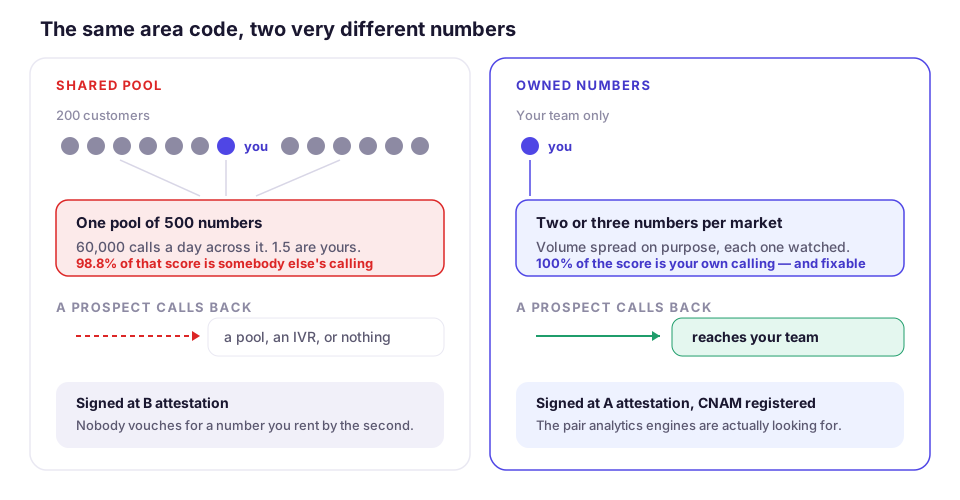
- Local presence lifts answer rates where the callee recognises the area code — provided the number is one you own rather than a pool number a stranger has already burned.
- Time of day, in the contact's time zone, moves answer rates more than any pacing setting.
- List quality. Validated, deduplicated, freshly sourced numbers answer; scraped lists do not, at any dialing speed.
Fit
Who a auto dialer is right for
If none of these describe you, a different mode probably fits better; the comparison pages lay out the trade-offs honestly.
- Teams running more than about 40 outbound calls per rep per day
- Anyone whose reps currently copy numbers out of a CRM by hand
- Operations that need different pacing for different lists in the same week
- Regulated sellers who need the compliance controls demonstrable, not assumed
Frequently asked questions
Is an auto dialer legal?
What is the difference between an auto dialer and a power dialer?
How much does an auto dialer cost?
Will an auto dialer get my numbers marked as spam?
Which mode should I start with?
Sources
- Telemarketing Sales Rule — Federal Trade CommissionDo-not-call obligations, abandonment-rate limits for predictive dialing, and required call disclosures.
- 47 U.S.C. § 227 — Restrictions on the use of telephone equipment — Cornell Legal Information InstituteThe Telephone Consumer Protection Act itself — the consent requirements, calling-hours limits, and private right of action.
- National Do Not Call Registry — Federal Trade CommissionThe registry that outbound calling lists must be scrubbed against.
Try auto dialer without a contract
No seat licences, no minimum commitment. Add a number, top up a wallet, and start. Release the number whenever you like; your remaining balance stays yours.
- No subscription
- Owned numbers with Attestation A
- Compliance built in