
Compare
Side-by-side comparisons
Not feature checklists: the two or three differences that actually determine which option is right for your list, your team size, and your regulatory position.
Reviewed by Sujan ThapaliyaLast updated
How should I compare calling platforms?
Compare on the two or three differences that change the outcome, not the feature grid: whether you pay per seat or per connected minute, whether the phone numbers are yours or rented from a shared pool, and what STIR/SHAKEN attestation level your calls are signed at. Those three decide cost and answer rate. Almost every other line item is common to all of them.
| Shared pool | Numbers you own | |
|---|---|---|
| Who else dials from the number | Up to 200 other customers on the same block | Only your team |
| Share of the number's reputation that is your calling | About 1.2% | 100%, and fixable |
| Highest STIR/SHAKEN attestation reachable | B — carrier knows the customer, not the number | A — carrier knows the customer and the number |
| Branded caller ID (CNAM) | Not registrable on a rotating pool | Registered against the number |
| Where a returned call lands | The pool, an IVR, or nowhere | Your team |
| What happens when the number gets flagged | You cannot see or fix another customer's calling | You see it per number and remediate it |
Comparisons
Which decision are you making?
Power dialer vs Parallel dialer
A power dialer places one call per rep at a time; a parallel dialer places several and connects the first human answer. Power dialling cannot abandon calls and suits warm or regulated lists. Parallel dialling produces far more conversations per hour on cold lists where most calls go unanswered.
Local number vs Toll-free number
A local number carries an area code tied to a place and signals you are nearby; a toll-free number is national and signals scale. Local numbers typically earn more inbound calls for regional businesses, while toll-free suits national brands, and most businesses benefit from using both.
Inbound vs Outbound
An inbound call is one a customer places to you; an outbound call is one you place to them. The distinction decides which metrics apply, how the team is staffed, and which regulations bind you — consent, calling hours and abandonment limits govern outbound calling and have no equivalent inbound.
Preview dialer vs Predictive dialer
A preview dialer shows the rep the record and dials on their signal, one call at a time. A predictive dialer places several calls per agent and connects whoever answers. Preview suits high-value lists where preparation changes the conversation; predictive suits large agent pools working cold lists.
Ooma vs magicJack
Both replace a landline with a small device and near-zero monthly cost. magicJack is cheaper and depends on an annual subscription and a plugged-in device. Ooma costs more upfront but adds a real feature set, better call quality on most reports, and a business tier. For a second home line, magicJack. For a line the household relies on, Ooma.
OpenPhone vs Dialpad
OpenPhone is a shared-number app built around conversations, and it is the simpler and cheaper of the two for a small team. Dialpad is a full business phone system with meetings, built-in AI transcription and a separate contact-centre product. The choice is really whether you need a phone system or a shared inbox with a number attached.
Five9 vs 8x8
Five9 is a contact-centre platform: dialling, routing, workforce management. 8x8 is a unified-communications suite with a contact centre inside it. If the contact centre is the business, Five9 is deeper. If you are also replacing the company phone system, 8x8 covers both from one vendor.
magicJack vs Vonage
magicJack is the cheapest way to keep a working phone number, on an annual subscription with a plugged-in device. Vonage costs meaningfully more each month and behaves like a phone service — features, support, business plans and international calling. The gap is not call quality so much as what happens when you need something beyond dial tone.
Talkroute vs RingCentral
Talkroute is a virtual phone system — numbers, menus and routing to devices you already own, with no hardware and a small plan. RingCentral is a full communications platform with meetings, messaging and a contact centre, licensed per seat. The question is whether you need business phone numbers or a company phone system.
OpenPhone vs Grasshopper
Grasshopper forwards a business number to phones you already own. OpenPhone is an app you actually work in, with shared numbers, a shared inbox and team collaboration. For one person who wants a professional number on a personal mobile, Grasshopper is simpler. For a team handling conversations together, OpenPhone.
RingCentral vs CallRail
These are not competitors. RingCentral is a phone system — how your company makes and receives calls. CallRail is call tracking — which marketing produced the call, recorded and attributed back to a campaign. Companies routinely run both, and choosing between them usually means the requirement has not been separated yet.
OpenPhone vs Google Voice
Google Voice is free for personal use and cheap through Workspace, and it is the lightest way to get a second number. OpenPhone costs per user and is built for a team — shared numbers, a shared inbox, proper business messaging. The trade is price against whether more than one person needs to see the conversation.
RingCentral vs Dialpad
RingCentral is the broader platform, with deeper international coverage, more integrations and the compliance record enterprise procurement expects. Dialpad is lighter and its real-time transcription and coaching are genuinely ahead. Both license per seat, and both keep outbound dialling in a separate contact-centre product.
IVR vs IVA
An IVR is a menu: press one for sales, press two for support. An IVA is an intelligent virtual agent that understands what the caller says, asks follow-up questions, and can complete the task rather than routing it. An IVR routes calls; an IVA handles them. Most businesses need both, at different points in the call.
Frequently asked questions
Should I compare dialers on features or on price?
On the two or three differences that change the outcome for your team, which is usually pricing shape rather than the feature grid. Nearly every dialer lists the same capabilities; what separates them is whether you pay per seat or per minute, whether the numbers are yours or rented from a shared pool, and what attestation level your calls are signed at.
When does a per-seat licence actually work out cheaper?
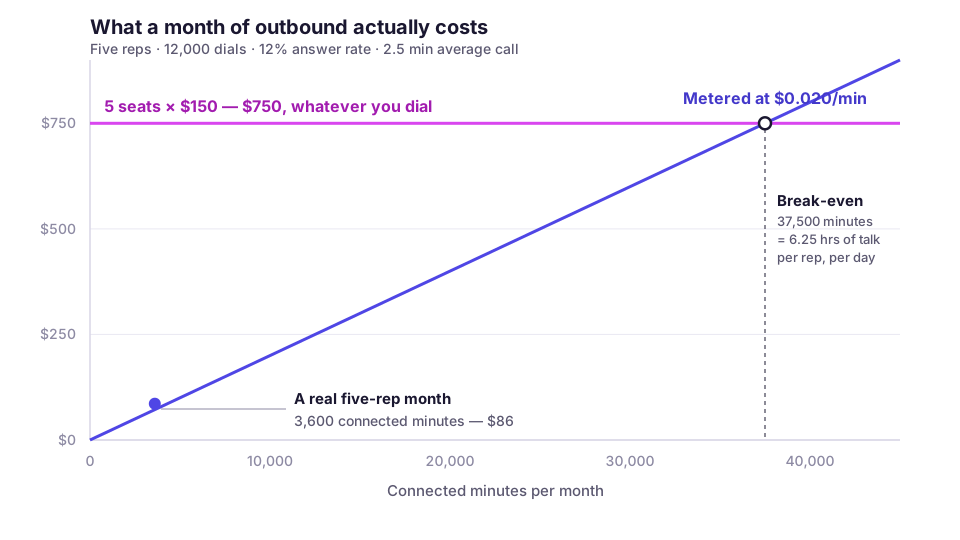
Only at genuinely high volume. A five-seat licence at $750 a month matches metered calling at $0.020 a minute once you pass 37,500 connected minutes — about 6.25 hours of live talk time per rep per working day. Teams that sustain that are rare; a realistic five-rep month runs nearer 3,600 connected minutes.
Does it matter whether the phone numbers are mine?
It is usually the single biggest factor in whether calls get answered. Caller-ID reputation attaches to the number, so on a shared pool almost all of it comes from other businesses’ calling and cannot be fixed by you, and calls can only be signed at B attestation. Numbers you own carry your calling alone and sign at A attestation.
Can I switch dialers without losing my phone numbers?
Yes. Numbers are portable between carriers, and porting moves them without a break in service — the number keeps ringing throughout. That is worth confirming before you sign anywhere, because a provider that will not let you port out is a provider you cannot leave.
Sources
- Telemarketing Sales Rule — Federal Trade CommissionDo-not-call obligations, abandonment-rate limits for predictive dialing, and required call disclosures.
- 47 U.S.C. § 227 — Restrictions on the use of telephone equipment — Cornell Legal Information InstituteThe Telephone Consumer Protection Act itself — the consent requirements, calling-hours limits, and private right of action.
- National Do Not Call Registry — Federal Trade CommissionThe registry that outbound calling lists must be scrubbed against.
You do not have to pick a product to pick a mode
Power, parallel, and predictive dialing are all in the base product. Switch per campaign, per list, or per hour of the day.
- Every dialing mode included
- No seat licences
- Compliance on by default