Dialers
Ringless voicemail: drop a message without ringing the phone
Reviewed by Sujan ThapaliyaLast updated
What is a ringless voicemail?
How it works
Ringless voicemail in four steps
No implementation project. Most teams are dialling the same day they sign up.
- 1
Record the message
Keep it short, name your business, and give a clear reason to call back. Fifteen to twenty seconds outperforms a minute every time. - 2
Verify consent
Upload the list with its consent basis. Contacts without a documented basis are held back rather than dropped. - 3
Pace the drops
Deliveries spread across your numbers and across the day rather than landing as one burst that carriers treat as spam. - 4
Route the callbacks
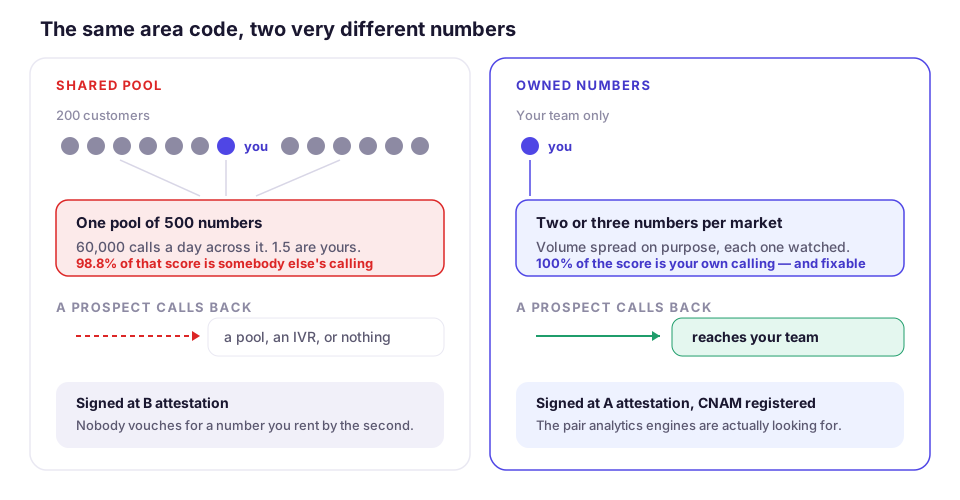
Returned calls come back to a real queue with the campaign context attached, not to a dead pool number.
Capabilities
What you get
Callback routing that works
Consent gating
Deliverability reporting
The legal position, stated plainly
Ringless voicemail was built on the argument that a message delivered without ringing the handset is not a call, and therefore sits outside the rules that govern calling. That argument has been consistently rejected. Treat a ringless drop exactly as you would treat the call: consent, do-not-call scrubbing, permitted hours in the recipient's time zone, and immediate opt-out handling.
- Consent first. If you would need it to call the number, you need it to leave a message in its mailbox.
- Scrub every time. Federal and state registries plus your own suppression list, on the same schedule you use for dialling.
- Respect the clock. Calling-hour limits follow the recipient's local time, not yours.
- Honour opt-outs across channels. Somebody who asked you to stop calling has asked you to stop leaving messages.
- Keep the records. The defence is the consent record, and it has to exist before the complaint, not after.
Where it is the right tool
Ringless voicemail earns its place where the recipient expects to hear from you and a ringing phone is the wrong interruption: service notifications, appointment changes, renewal reminders, and second-touch follow-ups to people who asked for information. In those cases it consistently outperforms both a call and an email, because it arrives without demanding the moment.
It is the wrong tool for cold acquisition, and the fact that no phone rang does not change that. The volume that makes cold ringless campaigns attractive is exactly the volume that produces the complaint pattern regulators act on.
Fit
Who a ringless voicemail is right for
If none of these describe you, a different mode probably fits better; the comparison pages lay out the trade-offs honestly.
- Real-estate investors and agents re-engaging warm lists
- Service businesses following up quotes and lapsed customers
- Anyone with documented consent and a genuinely useful message
Frequently asked questions
Is ringless voicemail legal in the US?
Does ringless voicemail hurt my number reputation?
What response rate should I expect?
Sources
- Telemarketing Sales Rule — Federal Trade CommissionDo-not-call obligations, abandonment-rate limits for predictive dialing, and required call disclosures.
- 47 U.S.C. § 227 — Restrictions on the use of telephone equipment — Cornell Legal Information InstituteThe Telephone Consumer Protection Act itself — the consent requirements, calling-hours limits, and private right of action.
- National Do Not Call Registry — Federal Trade CommissionThe registry that outbound calling lists must be scrubbed against.
Try ringless voicemail without a contract
No seat licences, no minimum commitment. Add a number, top up a wallet, and start. Release the number whenever you like; your remaining balance stays yours.
- No subscription
- Owned numbers with Attestation A
- Compliance built in