
Blog
How calling actually works
Deliverability, dialing, AI voice, and compliance, written from operating this infrastructure rather than from a keyword brief. Ordered by usefulness, not by date.
Reviewed by Sujan ThapaliyaLast updated
Start here
Where should you start?
Buying guides
Parallel dialer software: which features are worth paying for, in numbers
Parallel dialer software needs four things that discriminate: adaptive line pacing, answering machine detection with a stated false-positive rate, agent pooling for surplus answers, and abandonment reporting per campaign. Accurate detection alone is worth 0.89 conversations per agent-hour. CRM sync and analytics are universal and should not decide the purchase.
Dialing
What AI actually changes in a parallel dialer (and what it doesn't)
The two places machine learning measurably improves parallel dialing — answering machine detection and line pacing — costed per agent-hour, and the places it is marketing.
Buying guides
How to pick a parallel dialer, and the one question that decides it
A weighted scorecard for choosing a parallel dialer, the categories of tool that sell one, and the single demo question — what happens when my connect rate doubles — that separates them.
Buying guides
Choosing what to buy
Buying guides
Parallel dialer software: which features are worth paying for, in numbers
Every feature checklist for parallel dialer software says the same six things. This one prices them — what each is worth in conversations per hour — and shows why the billing model matters more than any of them.
Buying guides
How to pick a parallel dialer, and the one question that decides it
A weighted scorecard for choosing a parallel dialer, the categories of tool that sell one, and the single demo question — what happens when my connect rate doubles — that separates them.
Buying guides
Parallel dialer vs power dialer: what you gain, and what it costs
The throughput difference between a power dialer and a parallel dialer, computed per agent-hour — plus the two costs the comparison charts leave out: abandoned calls and how fast the list burns.
Buying guides
How to choose a business phone system (without overbuying)
The five questions that determine which business phone system fits, how per-seat and usage pricing really compare, and the requirements teams discover too late.
Dialing
Dialing and outbound
Dialing
What AI actually changes in a parallel dialer (and what it doesn't)
The two places machine learning measurably improves parallel dialing — answering machine detection and line pacing — costed per agent-hour, and the places it is marketing.
Dialing
What is a parallel dialer, and how many lines can you actually run?
How a parallel dialer works, the arithmetic that decides how many lines one agent can run, and why the answer is almost always smaller than the number your vendor puts in the settings box.
Dialing
Auto dialers explained: power, parallel, predictive, and preview
What each dialing mode actually does, the arithmetic behind the throughput claims, which one suits your list and team size, and what an auto dialer really costs.
Dialing
Cold calling scripts that survive contact with a real prospect
A structure for cold call openers that earns the next thirty seconds, handling for the four objections that account for most hang-ups, and the lines to delete from your script today.
Operations
Running the phone system
Operations
Erlang C for people who hate maths: how many agents a phone queue actually needs
What an Erlang is, how the staffing formula works, and the two results that surprise everyone: why one extra agent moves service level so much, and why staffing to a daily average fails at the same cost.
Operations
The FTC already wrote your sales call report template
Most sales call report templates track how the rep felt about the call. The Telemarketing Sales Rule specifies nine fields you must already retain for five years. Here is the template built from those, and the sample filled in.
Operations
Call forwarding: every code, what it does, and how to turn it off
The GSM star codes that set, check, and cancel call forwarding, what conditional and unconditional forwarding actually mean, and why “voice not forwarded” appears.
Operations
Call centre metrics that actually change decisions
The formulas for adherence, occupancy, shrinkage, service level and abandonment, what each one is really telling you, and the targets that quietly cause harm.
Operations
No caller ID, blocked, restricted, private: what each one means
The difference between withheld, unknown, and restricted numbers, how to hide your own number legitimately, how to stop anonymous calls reaching you, and what you cannot do.
Operations
Porting a business phone number: how it works and what goes wrong
What number porting actually involves, the four reasons ports get rejected, how long it really takes, and the sequence that avoids losing calls on cut-over day.
Research
Numbers we counted ourselves
Opinion
Arguments we will defend with arithmetic
Opinion
Local presence dialing is a slow way to burn numbers you don't own
Shared local-presence pools inherit every other customer's complaints, can't take a callback, and cap you at B attestation. The arithmetic, the rule that bites, and what to do instead.
Opinion
Per-seat dialer pricing bills your headcount, not your calls
A seat licence prices the chair, not the conversation. Here is the break-even arithmetic, the cost per connected conversation, and the four line items seat pricing quietly hides.
Opinion
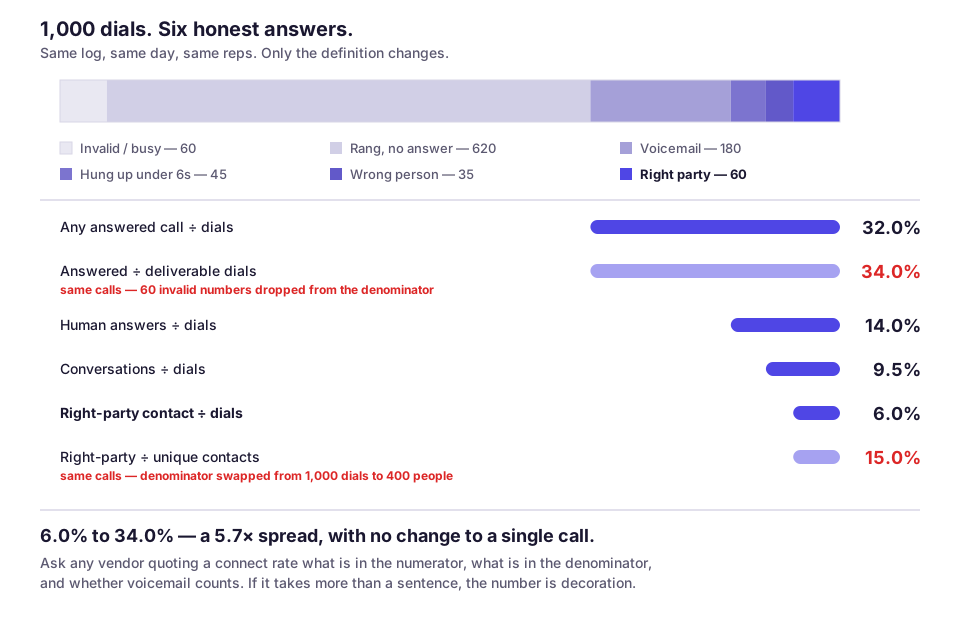
The same 1,000 calls produced six different “connect rates”
Connect rate has no standard definition, so vendors pick the one that flatters them. Here is the same call log scored six legitimate ways (6.0% to 34.0%) and the metric that cannot be gamed.
Deliverability
Getting your calls answered
Deliverability
Why your calls show as “Spam Likely”, and how to fix it
Carrier analytics label calls, not businesses. Here is exactly what triggers a Spam Likely label, how to get one removed, and the settings that stop it coming back.
Deliverability
Number reputation management: how to stop burning phone numbers
Phone numbers have a credit score. Here is what damages it, how to detect damage early from your own data, and the operating rules that keep a pool of numbers healthy.
Deliverability
STIR/SHAKEN and CNAM, explained for people who make calls
What STIR/SHAKEN attestation actually does, why Attestation A needs owned numbers, how CNAM differs from branded calling, and what to set up before your next campaign.
Deliverability
Local presence dialing: does it still work, and is it legal?
Why local numbers still lift answer rates, the shared-pool trap that destroys the benefit, and exactly where local presence crosses the line into illegal spoofing.
Compliance
Staying on the right side of the rules
Compliance
TCPA compliance for outbound calling: the practical guide
What consent you actually need, which calling hours apply, how the 3% abandonment rule works, and the records that decide whether you win or lose a claim.
Compliance
A2P 10DLC registration: why your business texts aren't arriving
What 10DLC is, why unregistered messages vanish without an error, how brand and campaign registration works, and what actually moves your throughput and trust score.
Frequently asked questions
Who writes these posts?
How often is new writing published?
What is the difference between the blog and the guides?
Can I reuse these figures?
Sources
- Combating Spoofed Robocalls with Caller ID Authentication — Federal Communications CommissionThe STIR/SHAKEN framework, the attestation levels carriers sign calls with, and the mandate requiring providers to authenticate caller ID.
- 47 U.S.C. § 227 — Restrictions on the use of telephone equipment — Cornell Legal Information InstituteThe Telephone Consumer Protection Act itself — the consent requirements, calling-hours limits, and private right of action.
- ITU-T Recommendation E.164 — The international public telecommunication numbering plan — International Telecommunication UnionThe international number format, the 15-digit maximum, and how country codes and national numbers compose.
Reading about it is the slow way
Owned numbers, branded caller ID, every dialing mode, and AI voice agents, set up properly, priced on usage, with no seat licences.
- No subscription
- Same-day setup
- Cancel anytime