Deliverability
STIR/SHAKEN and CNAM, explained for people who make calls
- 7 min read
By Sujan ThapaliyaLast updated
The short answer
Two systems decide what a person sees when your call arrives, and they are frequently confused with each other. One answers “can this caller ID be trusted?”. The other answers “whose name goes on the screen?”. You need both, they are configured in different places, and getting one right does not get you the other.
STIR/SHAKEN: is this caller ID real?
Caller ID was designed in an era when only carriers could originate calls, so it was never authenticated: the originating network simply asserted a number and everyone downstream believed it. That assumption is what made mass caller-ID spoofing trivially cheap.
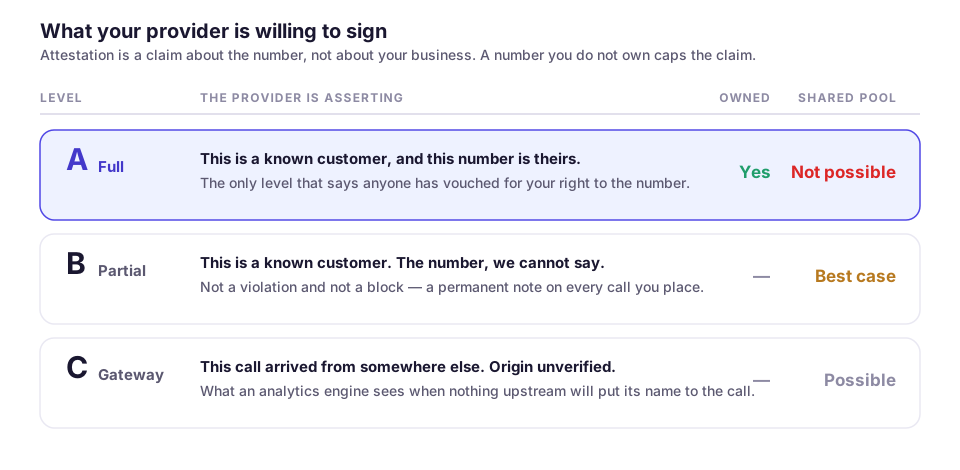
STIR/SHAKEN fixes the trust gap without changing how you dial. When your provider originates a call, it signs it with a certificate and includes a claim about how confident it is in your right to use that calling number. The terminating carrier verifies the signature and passes the claim to its analytics engine.
| Level | What the originating provider is asserting | Typical situation |
|---|---|---|
| A: Full | I know this customer, and I confirm they have the right to use this calling number. | A number you bought from the provider that is originating the call. |
| B: Partial | I know this customer, but I cannot confirm the origin of this number. | A number you brought from elsewhere and are presenting as caller ID. |
| C: Gateway | I passed this call along. I cannot vouch for the customer or the number. | Wholesale or international traffic transiting the network. |
This is why rented pool numbers underperform
Attestation is not a spam verdict in itself. It is an input (a well-weighted one) into the analytics models that decide whether to display your call normally, label it, or block it outright. A calls get the benefit of the doubt; C calls get very little.
CNAM: whose name shows on the screen
CNAM (caller ID name) is much older and works in a way that surprises most people: the name is not sent with the call. The receiving carrier takes the calling number, looks it up in a shared database, and displays whatever it finds.
Three practical consequences follow from that lookup model:
- Updates are not instant. Different carriers refresh their caches on different schedules. Register a new name and allow several days before a campaign depends on it.
- You get 15 characters. Not 15 words. “Bright Insurance Group of Greater Chicago” is not going to fit; decide what the 15 characters say before someone else decides for you.
- Not every carrier honours it. Mobile carriers increasingly prefer their own branded-calling programmes over the legacy database, and some display nothing at all rather than an unverified name.
If you register nothing, the handset shows a bare number, or a guessed city name, or “Unknown”. Every one of those is answered less often than a name.
Branded calling is a third thing
Newer branded-calling programmes go further than CNAM: they display a verified business name, a logo, and sometimes a reason for the call, on the incoming-call screen itself. They are run per carrier, require identity verification, and generally cost money per number or per call.
They are worth evaluating if your outbound volume justifies it, and they are not a substitute for the two layers underneath. Branded calling on a number with a poor reputation and Attestation C does not save the call.
The order to set these up in
- 1
Own the numbers you will call from
This is a prerequisite, not a preference. It is what makes Attestation A possible and what makes callbacks reach your team. - 2
Confirm attestation on a live call
Ask your provider what attestation your outbound calls carry. If the answer is B or C, find out why before you spend anything on remediation or branded calling. - 3
Register CNAM on every outbound number
Pick the 15 characters deliberately. Use the name people would recognise, not your legal entity name: “Northgate Dental” beats “NGD HOLDINGS LLC”. - 4
Register with the analytics providers
Free, and it lets you declare your numbers and call reasons before a model has to guess. This is also the channel through which you would later request remediation. - 5
Then consider branded calling
Once the foundation holds, the incremental lift from a logo on the screen is real. Before that, it is decoration on a call that is already being filtered.
What this does not fix
Signing and naming a call tells the network who you are. It says nothing about whether the person wants the call, and the analytics models weight behaviour heavily. A perfectly attested, beautifully named number still gets labelled if it makes eight hundred calls a day that nobody answers.
The layers work together: attestation and CNAM buy you the benefit of the doubt, and number reputation management keeps you from spending it. See also why calls show as Spam Likely for the behavioural side.
Outside North America
STIR/SHAKEN is a North American framework. Other regions are addressing the same problem differently: the UK and EU through number-integrity obligations on originating providers, and several Asian markets through registered-sender schemes closer in spirit to branded calling than to call signing.
The practical advice generalises anyway. Own your numbers, register your identity with whoever the local gatekeeper is, keep per-number volume sane, and make sure a callback reaches a human. Those hold in every market, whatever the acronym.
How to check what your calls are actually carrying
Both systems are invisible from your side of the call, which is why teams operate for months on an assumption. Three checks settle it.
- 1
Ask your provider for the attestation level, in writing
Not “we support STIR/SHAKEN”; every provider says that. Ask what level *your* outbound calls are signed at, and why. If the answer is B, the usual reason is that the number is not one they issued you. - 2
Call a handset on each major network
Look at what displays: your business name, a bare number, a guessed city, or a spam label. This is the only test that reflects what a customer actually sees. - 3
Check the CNAM record itself
Several free lookup services return the registered name for a number. If it shows nothing, or shows a previous owner's name, the record was never created or never updated after a port.
Ported numbers are the classic gap
Common misconceptions worth clearing up
- “STIR/SHAKEN stops spam calls.” It does not stop anyone dialling. It makes it much harder to *present a number you do not own*, which removes the disguise rather than the caller.
- “Attestation A means my calls will not be labelled.” No. Attestation is one input among several, and behaviour still dominates. A well-signed number making eight hundred unanswered calls a day is still scored as automated.
- “CNAM is instant.” It is a cached database lookup performed by the receiving carrier, so propagation is uneven and takes days.
- “My provider controls what displays.” For CNAM, the receiving carrier decides; your provider only maintains the record it reads.
- “Setting my caller ID to any number is fine as long as I own the account.” Only if you own the *number*. Presenting a number you do not control is where the Truth in Caller ID Act starts to apply.
Frequently asked questions
What is Attestation A and why does it matter?
What is the difference between CNAM and STIR/SHAKEN?
How long does a CNAM update take to appear?
Can I put any name I want in CNAM?
Do I need branded calling as well?
Sources
- Combating Spoofed Robocalls with Caller ID Authentication — Federal Communications CommissionThe STIR/SHAKEN framework, the attestation levels carriers sign calls with, and the mandate requiring providers to authenticate caller ID.
- 47 CFR Part 64 — Miscellaneous Rules Relating to Common Carriers — Electronic Code of Federal RegulationsThe operative federal rules on caller ID transmission, call authentication, and robocall mitigation.
See it working: power dialer
A power dialer places one outbound call at a time from a loaded list, automatically dialling the next contact the moment the previous call ends. It removes manual dialling and hold time without the connection delay that makes predictive dialling feel robotic to the person who answers.
- No subscription
- Numbers in 100+ countries
- Compliance built in