
Skip to content
AI Dialer

Compare

Alternatives, written honestly

Every page here names what the other product is genuinely good at. If it fits your team better, we would rather you knew that than churned in three months.

Reviewed by Sujan ThapaliyaLast updated

How should you compare business phone platforms?
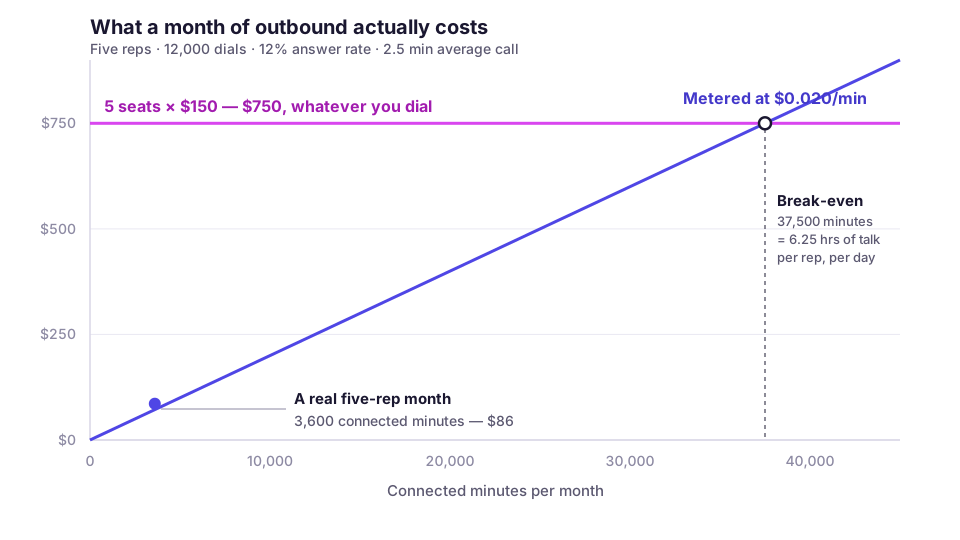
Do one calculation before reading any feature list: total monthly cost divided by the number of conversations your team actually has. Per-seat pricing wins when every seat dials constantly. Usage pricing wins when volume is uneven, seasonal, or spread across part-time staff, which describes most teams. Everything else is a detail.
Where per-seat pricing stops making sense: a flat five-seat licence costs $750 a month whatever the usage, while metered calling at $0.020 a minute only reaches that figure at 37,500 connected minutes — 6.25 hours of talk time per rep every working day. Most teams comparing alternatives are nowhere near that line.
Most switching decisions come down to this chart rather than the feature list.
Shared number pool compared with numbers you hold exclusively
Shared poolNumbers you own
Who else dials from the numberUp to 200 other customers on the same blockOnly your team
Share of the number's reputation that is your callingAbout 1.2%100%, and fixable
Highest STIR/SHAKEN attestation reachableB — carrier knows the customer, not the numberA — carrier knows the customer and the number
Branded caller ID (CNAM)Not registrable on a rotating poolRegistered against the number
Where a returned call landsThe pool, an IVR, or nowhereYour team
What happens when the number gets flaggedYou cannot see or fix another customer's callingYou see it per number and remediate it

Alternatives

Which platforms do teams compare us against?

OpenPhone alternative

People look for an OpenPhone alternative when they outgrow its per-user pricing or need outbound calling at volume.
Business phone app

Dialpad alternative

Teams look for a Dialpad alternative when they want outbound dialling depth or dislike per-seat licensing.
Cloud phone system

CloudTalk alternative

A CloudTalk alternative is usually sought over per-seat pricing or number availability in specific countries.
Call centre software

CallHippo alternative

CallHippo is a virtual phone system with international numbers and a power dialler on higher plans.
Virtual phone system

Nooks alternative

Nooks is a parallel dialler built for SDR teams, with a virtual sales floor and coaching tools.
Parallel dialer

magicJack alternative

magicJack is a low-cost consumer VoIP device and app.
Consumer VoIP

Google Voice alternative

Google Voice gives you a free or low-cost second number with voicemail and texting.
Virtual phone number

Talkdesk alternative

Talkdesk is an enterprise contact-centre platform with deep workforce and analytics tooling.
Enterprise contact centre

RingCentral alternative

Teams look for a RingCentral alternative when they are paying per seat, on an annual term, for a suite whose meetings and chat they barely use.
Cloud phone system (UCaaS)

ShoreTel alternative

ShoreTel was acquired by Mitel in 2017 and the ShoreTel-branded lines have been progressively wound down in favour of Mitel's own platforms.
Legacy on-premise PBX

MightyCall alternative

People look for a MightyCall alternative when a small-business phone plan stops fitting an outbound team.
Small-business virtual phone system

Ooma alternative

People look for an Ooma alternative when a service designed around a device in the office stops fitting a team that calls out.
Small-business and home VoIP

Vonage alternative

Teams look for a Vonage alternative when they are paying per seat for a business phone system and discovering that outbound dialling sits in a different product.
Business VoIP and communications APIs

Grasshopper alternative

People look for a Grasshopper alternative when forwarding calls to mobiles stops being enough.
Virtual phone number service

Five9 alternative

Teams look for a Five9 alternative when they need contact-centre capability without an enterprise procurement cycle.
Enterprise contact centre (CCaaS)

8x8 alternative

Teams look for an 8x8 alternative when they are buying a whole unified-communications suite to get the calling.
Unified communications and contact centre

Aircall alternative

Teams look for an Aircall alternative when per-seat pricing with a minimum seat count stops fitting, or when they need dialling throughput Aircall does not offer.
Cloud call centre for sales and support

Nextiva alternative

Teams look for a Nextiva alternative when a business phone plan priced per user stops matching how they actually work.
Business VoIP and customer experience

JustCall alternative

Teams look for a JustCall alternative when the per-seat plan plus add-ons stops adding up.
Sales phone and messaging platform

Mojo Dialer alternative

Agents look for a Mojo Dialer alternative when the numbers they dial from start getting labelled, or when per-user plus per-line pricing stops making sense.
Real-estate prospecting dialler

Phone.com alternative

People look for a Phone.com alternative when a small-business phone plan stops covering how much the team calls.
Small-business VoIP

eVoice alternative

People look for an eVoice alternative when an answering service stops matching the work.
Virtual number and answering service

Frequently asked questions

Why write about competitors at all?
Because the comparison happens whether we take part or not, and the version written by somebody trying to win usually reads as such. These pages say what each platform is genuinely good at, and where teams outgrow it, which is more useful to a buyer than a feature grid with all the ticks on one side.
Do these pages quote competitor pricing?
No, deliberately. Published prices go stale within a quarter and quoting them creates a liability. What we compare is the pricing model — per seat versus per minute, what a number costs, what is bundled — because that is what actually changes the bill at your volume.
What is the main difference between this platform and most alternatives?
Two things. Numbers here are provisioned to you rather than drawn from a shared pool, which decides caller-ID reputation and attestation level. And billing is usage-based with no seat licences, which changes the maths for any team where not everybody dials every day.
Can I move my numbers from another provider?
Yes. Numbers are portable between carriers and porting keeps them ringing throughout. A provider that makes porting out difficult is worth noticing during evaluation, not after.

Sources

  1. Combating Spoofed Robocalls with Caller ID AuthenticationFederal Communications CommissionThe STIR/SHAKEN framework, the attestation levels carriers sign calls with, and the mandate requiring providers to authenticate caller ID.
  2. 47 U.S.C. § 227 — Restrictions on the use of telephone equipmentCornell Legal Information InstituteThe Telephone Consumer Protection Act itself — the consent requirements, calling-hours limits, and private right of action.
  3. ITU-T Recommendation E.164 — The international public telecommunication numbering planInternational Telecommunication UnionThe international number format, the 15-digit maximum, and how country codes and national numbers compose.

Compare on your own numbers

Port a number, run a week of real calls, and measure cost per conversation. There is no contract to unwind if the answer goes the other way.

  • Numbers port in
  • No subscription
  • Cancel anytime