
About
Who builds this, and why the numbers can be checked
AI Dialer is a business phone platform built around one idea: a call gets answered because the number placing it is yours, is registered, and has a reputation you can see, not because a dialer rotated through somebody else's.
Last updated
In short
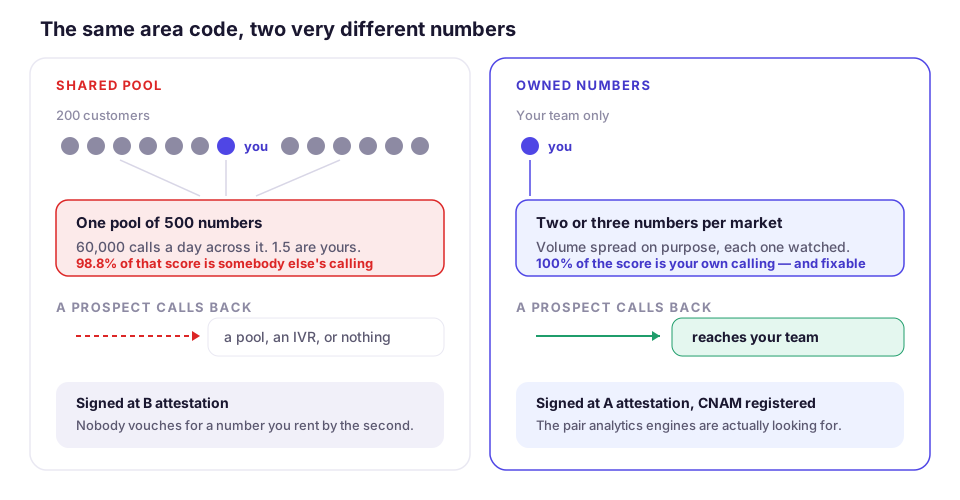
| Shared pool | Numbers you own | |
|---|---|---|
| Who else dials from the number | Up to 200 other customers on the same block | Only your team |
| Share of the number's reputation that is your calling | About 1.2% | 100%, and fixable |
| Highest STIR/SHAKEN attestation reachable | B — carrier knows the customer, not the number | A — carrier knows the customer and the number |
| Branded caller ID (CNAM) | Not registrable on a rotating pool | Registered against the number |
| Where a returned call lands | The pool, an IVR, or nowhere | Your team |
| What happens when the number gets flagged | You cannot see or fix another customer's calling | You see it per number and remediate it |
People
The byline is a person, not a content team
Sujan Thapaliya
Founder
Builds the carrier integrations, dialing engine, and compliance tooling this site documents. The figures in these posts come from the same rate tables and call records the product runs on.
Editorial method
How a claim gets onto this site
Most of what is written about call deliverability is confidently wrong in the same few ways. These are the rules that keep this site from adding to it.
- 1
Prices are derived, never typed
Every published rate is computed from the carrier cost we actually pay, with the markup formula written out in the source. Nobody can hand-edit a price into a page, so the rate card and the invoice cannot disagree. - 2
Reference data is structured, then rendered
Country codes, area codes, number formats, and dialing rules live as data and are rendered into pages. A correction lands in one place and propagates everywhere it appears, rather than being fixed on the page somebody happened to notice. - 3
Worked examples state their assumptions
Where a post computes something (a break-even, a cost per conversation, a contamination rate) the inputs are written above the arithmetic so you can substitute your own and get a different answer. A figure you cannot reproduce is a figure you should not trust. - 4
Regulation is described, not paraphrased into advice
Compliance pages explain what a rule requires and where it applies. They do not tell you that you are compliant, because that depends on facts about your business that a web page cannot know. - 5
Example numbers are fiction ranges
Sample phone numbers use regulator-reserved ranges where one exists, and are otherwise labelled as format patterns. No real subscriber's line is used as an illustration.
Positions
Where we disagree with the industry
Arguments, not explainers. Each one states its assumptions and shows the arithmetic, so it can be argued with on the numbers.
Local presence dialing is a slow way to burn numbers you don't own
Shared local-presence pools inherit every other customer's complaints, can't take a callback, and cap you at B attestation. The arithmetic, the rule that bites, and what to do instead.
Per-seat dialer pricing bills your headcount, not your calls
A seat licence prices the chair, not the conversation. Here is the break-even arithmetic, the cost per connected conversation, and the four line items seat pricing quietly hides.
The same 1,000 calls produced six different “connect rates”
Connect rate has no standard definition, so vendors pick the one that flatters them. Here is the same call log scored six legitimate ways (6.0% to 34.0%) and the metric that cannot be gamed.
Contact
Reaching a person
- Sales: [email protected]
- Support: [email protected]
- Writing: RSS feed
Frequently asked questions
Who writes the content on this site?
How is AI Dialer priced?
Where do the figures in the articles come from?
How do I get in touch?
Can I quote or cite this site?
Sources
- Combating Spoofed Robocalls with Caller ID Authentication — Federal Communications CommissionThe STIR/SHAKEN framework, the attestation levels carriers sign calls with, and the mandate requiring providers to authenticate caller ID.
- 47 U.S.C. § 227 — Restrictions on the use of telephone equipment — Cornell Legal Information InstituteThe Telephone Consumer Protection Act itself — the consent requirements, calling-hours limits, and private right of action.
- ITU-T Recommendation E.164 — The international public telecommunication numbering plan — International Telecommunication UnionThe international number format, the 15-digit maximum, and how country codes and national numbers compose.
Owned numbers, published prices, no seats
Local, mobile, and toll-free numbers in over 100 countries, branded caller ID, every dialing mode, and AI voice agents, billed per minute, from a prepaid wallet.
- No seat licences
- No minimum
- Published rates