
Solutions
Every industry has a different reason the phone fails
An insurance agency loses on speed-to-lead. A clinic loses on HIPAA. A restaurant loses because nobody can pick up during service. Same platform, different constraints; these pages start from the constraint.
Reviewed by Sujan Thapaliya
Industry pages here describe the actual operating constraint (the regulation, the answer-rate economics, the call pattern) and then the configuration that handles it. Compliance controls such as TCPA consent tracking, calling-hour windows, DNC suppression, and recording-consent announcements are enforced by the platform rather than left as policy for your team to remember.
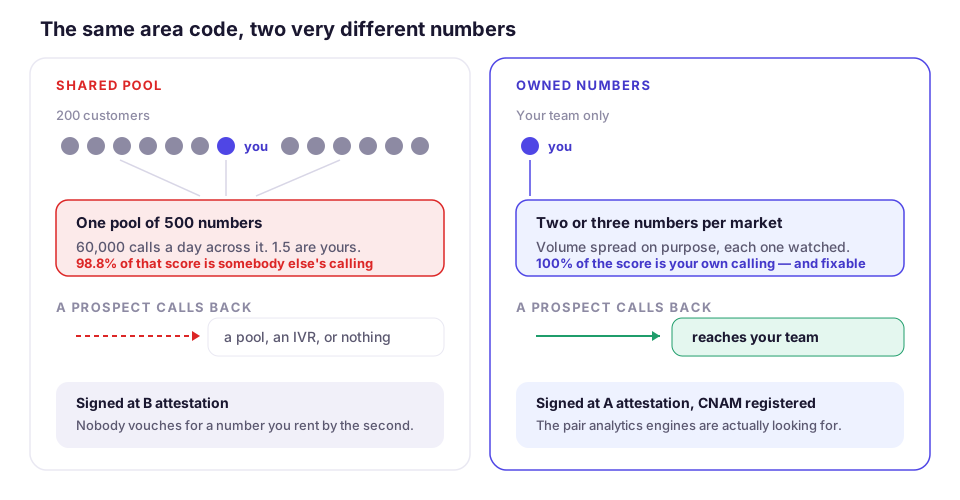
| Shared pool | Numbers you own | |
|---|---|---|
| Who else dials from the number | Up to 200 other customers on the same block | Only your team |
| Share of the number's reputation that is your calling | About 1.2% | 100%, and fixable |
| Highest STIR/SHAKEN attestation reachable | B — carrier knows the customer, not the number | A — carrier knows the customer and the number |
| Branded caller ID (CNAM) | Not registrable on a rotating pool | Registered against the number |
| Where a returned call lands | The pool, an IVR, or nowhere | Your team |
| What happens when the number gets flagged | You cannot see or fix another customer's calling | You see it per number and remediate it |
Industries
Which industry page fits your team?
Insurance
Insurance dialer software combines speed-to-lead dialling with the consent tracking the TCPA demands.
Real estate
Real-estate calling software works cold lists at volume: skip-traced owner records, expired listings, and FSBOs.
Healthcare
A HIPAA-compliant phone system protects protected health information across calls, voicemails, texts, and recordings, with a signed business associate agreement, encryption in transit and at rest, access logging, and retention controls.
Restaurants
A restaurant phone system has one job: never let a booking or order go unanswered while the floor is busy.
Recruiting
Recruiting runs on call volume: passive candidates rarely answer the first attempt, and screening calls follow the same script every time.
Financial services
Financial-services calling carries recordkeeping obligations that ordinary business phones do not meet: conversations must be captured, retained for years, and retrievable on request.
Law firms
For a law firm the phone is the intake channel: a prospective client who reaches voicemail calls the next firm on the results page.
Churches & nonprofits
A church phone tree sends one message to an entire congregation by phone in minutes: service cancellations, prayer chains, and event reminders.
BPO & outsourcing
A BPO platform has to keep several clients' campaigns, numbers, recordings, and reports strictly separate while sharing one agent pool, and it has to scale headcount up and down without renegotiating licences every time a contract starts or ends..
Hotels & hospitality
Hospitality phone handling is a revenue problem disguised as an operations one.
Fintech & lending
Fintech and lending calls carry two obligations at once: they are marketing calls subject to consent rules, and they are financial conversations subject to recordkeeping.
Staffing & HR
Staffing runs on two activities that scale badly with headcount: reaching candidates who rarely answer, and asking every one of them the same screening questions.
Education
Education telephony splits into two very different jobs: reaching every family quickly when something changes, and answering admissions enquiries that arrive in seasonal waves.
Home services & trades
For a trade business the phone is the entire sales channel, and it rings while you are under a sink.
Automotive
Dealership phone handling decides whether an advertising spend produces appointments.
Frequently asked questions
Why does the industry matter for a phone system?
Because the constraints differ more than the features do. A therapist's practice and an insurance agency both make outbound calls, but one is governed by patient confidentiality and the other by consent records and calling windows. The industry decides which controls have to be on by default.
My industry is not listed. Does the platform still fit?
Usually. The pages here cover the industries whose constraints we have written up properly, not the limits of who uses it. The honest test is whether your calling pattern resembles one of these — high-volume outbound, appointment-driven inbound, or regulated record-keeping.
Do you handle compliance for my industry?
We provide the controls: consent capture, do-not-call suppression, calling windows in the contact's time zone, recording announcements and per-number caps. Whether a specific campaign is lawful is a question for your counsel, and nothing on this site is legal advice.
Can one account serve several industries?
Yes. Workspaces separate numbers, contacts, recordings and reporting, so an agency or a multi-brand business can run different compliance settings per line of business without separate accounts.
Sources
- Combating Spoofed Robocalls with Caller ID Authentication — Federal Communications CommissionThe STIR/SHAKEN framework, the attestation levels carriers sign calls with, and the mandate requiring providers to authenticate caller ID.
- 47 U.S.C. § 227 — Restrictions on the use of telephone equipment — Cornell Legal Information InstituteThe Telephone Consumer Protection Act itself — the consent requirements, calling-hours limits, and private right of action.
- Telemarketing Sales Rule — Federal Trade CommissionDo-not-call obligations, abandonment-rate limits for predictive dialing, and required call disclosures.
Not on the list?
The constraints repeat more than you would expect: consent, calling hours, recording, and answer rates cover most of it. Tell us what your team does and we will point you at the right configuration.