
Opinion
Per-seat dialer pricing bills your headcount, not your calls
- 8 min read
By Sujan ThapaliyaLast updated
The short answer
Seat pricing survived from an era when the software ran on a box in your building and the vendor's cost genuinely scaled with the number of people logged into it. That has not been true for fifteen years. What scales now is minutes, messages, and numbers, all three of which the vendor is metered on by a carrier, and all three of which they can meter you on exactly.
They meter you on chairs instead, because chairs go up and to the right on a board slide and minutes do not.
Seat pricing is not a price for calling. It is a price for hiring, collected by a company that does not employ anyone you hired.
The break-even, worked out in full
Take a five-person outbound team on a fairly ordinary plan: $150 per seat per month, $750 total. Compare it with metered pricing at $0.020 per connected minute in the US and $1.38 per local number per month, which is our published rate card, not a hypothetical.
Assumptions, stated so you can substitute your own: 120 dials per rep per day, 20 working days, a 12% answer rate, and 2.5 minutes on an average connected call. Unanswered calls are not billed per-minute by any carrier worth using, so only connected minutes count.
| Line | Metered | Per-seat |
|---|---|---|
| Dials placed | 12,000 | 12,000 |
| Connected conversations (12%) | 1,440 | 1,440 |
| Connected minutes (2.5 min avg) | 3,600 | 3,600 |
| Voice: 3,600 × $0.020 | $72.00 | included |
| Numbers: 10 local × $1.38 | $13.80 | usually extra |
| Licences: 5 × $150 | n/a | $750.00 |
| Monthly total | $85.80 | $750.00 |
| Cost per connected conversation | $0.06 | $0.52 |
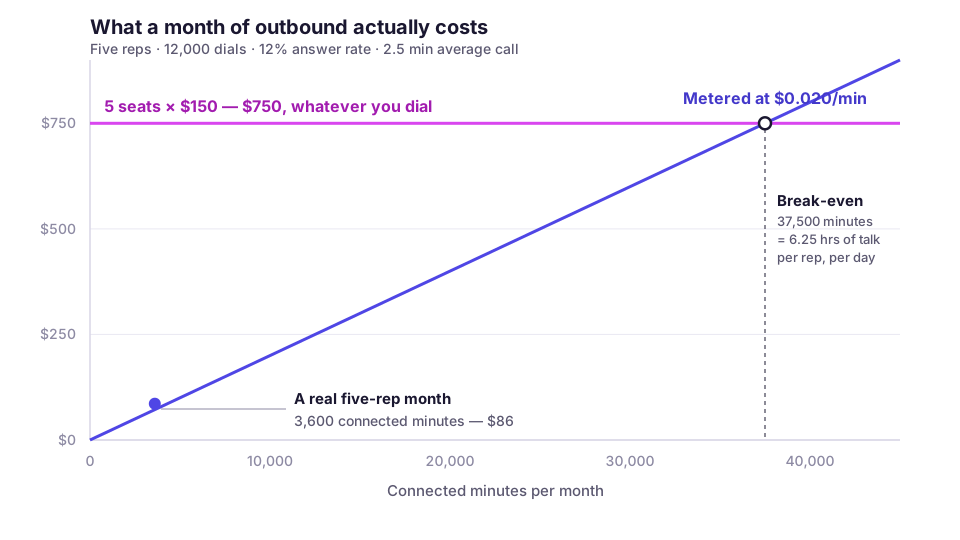
Now run it the other way. At $0.020 a minute, $750 buys 37,500 connected minutes. Across five reps over 20 working days that is 6.25 hours of live, answered, person-to-person talk time per rep per day, not dial time, not admin, not CRM notes. Talk time.
6.25 hrs
Connected talk time per rep per day to break even
8.7×
Cost per conversation, seat vs metered
$0
Refunded for the seat that sat empty in August
There is no outbound team on earth sustaining six hours of connected talk time per rep per day, every day, for a month. Which means the seat plan is not a volume discount that pays off at scale. Below its break-even it is a markup, and its break-even is above the physical ceiling of the work.
The four line items a seat hides
The sticker price is the smaller half of the argument. What makes seat pricing expensive is the structure around it, and every element of that structure moves in the vendor's direction.
- You pay for absence. Holiday, sick leave, training weeks, the two weeks a new hire spends shadowing before they dial. Every one is billed at the full rate for zero calls.
- You pay for churn twice. A rep leaves in month three of a twelve-month contract; you keep paying for their seat and you pay again for their replacement's seat if you are over your committed count.
- You cannot flex down. Seat counts on annual contracts ratchet up and almost never down mid-term. Seasonality (which every outbound business has) becomes a cost you eat rather than a cost that follows demand.
- Usage is often still charged on top. Read the order form. On many plans the licence buys the interface, and minutes, numbers, recordings, and transcription are billed separately anyway. You are paying a subscription for the privilege of being metered.
The test that exposes it
The distortion is worse than the money
The direct cost is survivable at five seats. What is not survivable is what a fixed per-head price does to how a team gets managed, because the moment a chair has a fixed monthly price attached, every operational decision gets made against that price instead of against results.
| Decision | Under per-seat | Under metered |
|---|---|---|
| Give a part-time SDR a login | Costs a full seat, so they share someone's, badly | Costs the minutes they actually use |
| Let a marketer run a 200-call test | Needs a seat approved and budgeted | Costs about $1.20, needs no approval |
| Add an AI voice agent to qualify a cold list | Vendor wants a seat for a robot | Priced per minute, like every other call |
| Cut a channel that is not working | Bill unchanged until renewal | Bill drops the same week |
| Run a seasonal December push | Twelve months of seats for a six-week campaign | December costs more, January costs less |
A fixed per-head price does not just cost more. It makes experiments expensive and idle headcount cheap, which is precisely backwards.
The row that gives the whole thing away is the AI one. When a vendor asks for a seat licence for an AI agent, they are charging a headcount price for something that has no head. The metaphor has stopped meaning anything and is now simply a lever. How AI voice agents get priced goes into what the underlying cost actually looks like.
What honest usage pricing has to include
"Usage-based" has already been diluted by vendors who kept the seat and bolted a meter on. If you are switching to escape seat pricing, these five properties are what you are actually buying, and their absence is how a usage plan becomes a seat plan wearing a meter.
- No minimum commitment. A floor is a seat licence with extra steps.
- Unlimited free users. Adding a person must cost nothing until that person places a call, or headcount is still the price.
- A published rate card. Per destination, per minute, visible before you sign, not "contact sales". Ours is on the pricing page.
- Prepaid, not invoiced-in-arrears. You should be able to see the balance draw down as calls happen, and stop at any moment.
- One meter for everything. Voice, SMS, numbers, AI minutes, transcription and recording on the same rate card, not four contracts.
Where usage pricing genuinely costs more
Run your own numbers before renewal
- 1
Pull last month's connected minutes
Not dials, not talk-time targets. Billed, answered minutes from your call detail records. Most teams are shocked by how small the number is. - 2
Divide your total dialer bill by it
That is your true cost per connected minute today, licences included. Compare it against a published per-minute rate for the same destinations. - 3
Divide the bill by connected conversations
Cost per conversation is the number to take to a budget meeting, because it is the only one that maps to pipeline. - 4
Compute the break-even hours
Monthly licence cost ÷ per-minute rate ÷ reps ÷ working days ÷ 60 = the hours of live talk time per rep per day the seat plan needs to be worth it. Compare that to what your team actually does. - 5
Take both numbers into the renewal call
Not "it feels expensive". A break-even in hours per rep per day is a claim your vendor has to answer with arithmetic rather than with a case study.
You may still choose the seat plan. Some teams will, for reasons that have nothing to do with price. But choose it knowing the multiple, rather than finding it out when finance asks why the phone system costs more than the ads that generate the list. The full buyer's comparison covers what else changes when the meter moves.
Frequently asked questions
Is per-seat pricing ever cheaper than usage-based pricing?
What is a good cost per connected conversation?
How do I calculate the break-even on my dialer contract?
Do usage-based dialers charge for extra users?
Why do dialer vendors want a seat licence for an AI agent?
Sources
- Combating Spoofed Robocalls with Caller ID Authentication — Federal Communications CommissionThe STIR/SHAKEN framework, the attestation levels carriers sign calls with, and the mandate requiring providers to authenticate caller ID.
- 47 U.S.C. § 227 — Restrictions on the use of telephone equipment — Cornell Legal Information InstituteThe Telephone Consumer Protection Act itself — the consent requirements, calling-hours limits, and private right of action.
- ITU-T Recommendation E.164 — The international public telecommunication numbering plan — International Telecommunication UnionThe international number format, the 15-digit maximum, and how country codes and national numbers compose.
See the platform
Owned numbers, branded caller ID, every dialing mode, and AI voice agents, priced on usage, with no seat licences.
- No subscription
- Numbers in 100+ countries
- Compliance built in