
Glossary · Numbering
What is Toll-free number?
- Also called: 800 number, freephone
Reviewed by Sujan ThapaliyaLast updated
Definition
In practice
How toll-free number actually works
Toll-free numbers are portable between providers and are administered through a shared national database, so you keep the number when you change carrier.
Vanity numbers spell a word on the keypad. Nearly every good combination in 800 is long gone, which is why the newer codes are where memorable numbers are still available.
Toll-free is not always the right choice. A local number often earns higher answer rates for a regional business, while toll-free signals national reach.
Toll-free numbers are also administered centrally rather than by your carrier, which has a practical consequence: the record of who controls one is held in a shared database, and moving it between providers is an administrative change rather than a technical migration. That is why toll-free numbers are among the easiest to port and the least risky to publish widely.
| Prefix | Introduced | Availability today |
|---|---|---|
| 800 | The original | Effectively exhausted; vanity numbers trade at a premium |
| 888 | After 800 | Widely recognised |
| 877 | After 888 | Widely recognised |
| 866 | After 877 | Widely recognised |
| 855 | After 866 | Plenty available |
| 844 | After 855 | Good vanity availability |
| 833 | Most recent in general use | Best availability |
Worked example
Toll-free number: common questions
Who pays for a toll-free call?
Is 833 a real toll-free number?
Can toll-free numbers send and receive texts?
Sources
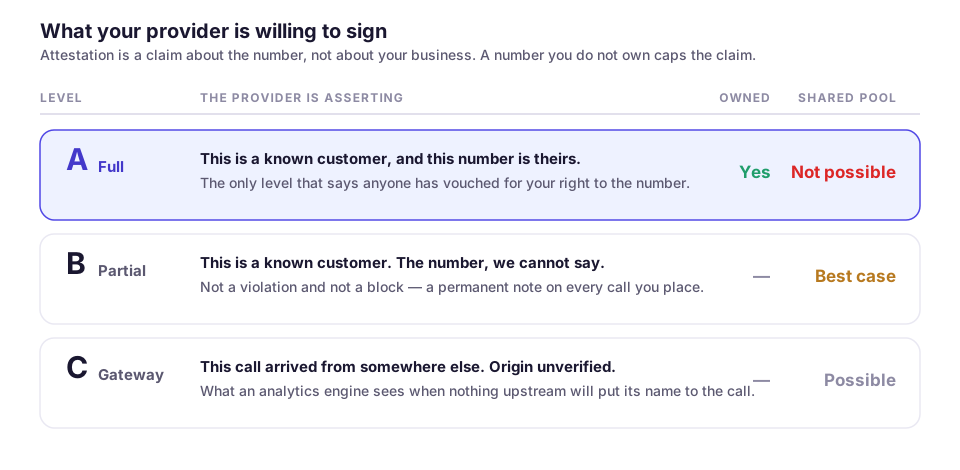
- Combating Spoofed Robocalls with Caller ID Authentication — Federal Communications CommissionThe STIR/SHAKEN framework, the attestation levels carriers sign calls with, and the mandate requiring providers to authenticate caller ID.
- 47 U.S.C. § 227 — Restrictions on the use of telephone equipment — Cornell Legal Information InstituteThe Telephone Consumer Protection Act itself — the consent requirements, calling-hours limits, and private right of action.
- ITU-T Recommendation E.164 — The international public telecommunication numbering plan — International Telecommunication UnionThe international number format, the 15-digit maximum, and how country codes and national numbers compose.
See toll-free number in the product
A toll-free number is one the called business pays for rather than the caller. In North America they use the prefixes 800, 833, 844, 855, 866, 877 and 888, which are functionally identical — the newer ones exist only because the older ones ran out. They signal national reach; a local number signals proximity.